I remember the day I took my daughter to a double feature. We were going to see "A Wrinkle in Time" and "Black Panther" back to back. I had been trying to get my daughter to watch superhero movies and somehow she was never drawn to them. When I walked into the theater I assumed she would love Wrinkle, a book she and I read together when she was 7 and maybe not enjoy Panther. It turned out to be the opposite! She found the colorful world of Wrinkle in the movie not jive with her mental image of the world from the book. On the other hand, she fell in love with Black Panther. There was something about the movie that appealed to her and since then we watched the 20 odd Avenger movies and she still ranks Black Panther as her favorite. The movie brought joy to billions and we were no exceptions. You didn't have to be black to appreciate what a force for good that movie was. Believe me, I have seen Indiana Jones Temple of Doom and know a thing or two about stereotypes in Hollywood. But Panther arguably did more than even Henry Louis Gates Jr's brilliant documentary on Africa to challenge Eurocentric (which is inevitably white-centric) views of the world. So, the death of Chadwick Boseman came as a shock to me like it did for the world. But I was unprepared for the intensity to which it would affect me.
Tuesday, September 1, 2020
Grace and Grief
Saturday, August 15, 2020
Wordsworth for the Weary
As you can see from the last few posts, being cooped up inside for nearly 6 months has guided my reading in one specific direction. Being deprived of the great outdoors I am vicariously living through literature. Jonathan Bate's Radical Wordsworth was not just about satiating my need for nature. It also had a lot to do with human connection. Come September, I will celebrate 25 years of friendship with two special people with whom I had the pleasure to visit Grasmere and other places in the Lake District that were fundamental to Wordsworth's poetry.
In Tintern Abbey, the prophet of nature wrote
Though absent long
These forms of beauty have not been to me,
As is a landscape to a blind man's eye;
But oft, in lonely rooms, and 'mid the din
Of towns and cities, I have owed to them,
In hours of weariness, sensations sweet
Grasmere and the lakes of Lake District have offered similar sweet sensations to my weary mind especially during this pandemic. Back in 1997 my friends and I were 23, carefree, just getting started in our careers and had the opportunity to work and travel in the UK albeit each in a different city. Since then a lot has happened in our lives, both ups and downs and we've pursued our own interests. However, it has remained a steady friendship, a constancy in our lives without the need for instant gratification and frequent validation. We don't care where the other person works, what their title is, what their career progression has been. We are not connected on Facebook, LinkedIn and we don't even talk frequently. As I get older I cherish the friendship even more now than I did in 1995. There are so many reasons that I am grateful to them for, but in the context of this post I am especially grateful that they humored my whims and wishes about the places I wanted to see in the UK and offered me their companionship.
Bate says he wrote this book for "anybody who raises an eyebrow when the poet's name is mentioned and the only word that comes to mind is daffodils." That was surely the case for us when we visited Grasmere back then. Since then I went on to read more of his verses from Lyrical Ballads for my M.A. in English and I am positive the other two have not read much Romantic poetry. Reading Bate's biography was going to be an opportunity for me to once more savor the landscape and the friendship and while it certainly achieved that, it offered me so much more.
Wordsworth often lamented about the fact of growing up. Growing up meant that the unity between the body, the self and the environment gets broken and the only way to recapture that "primal spirit" was through poetry and memory. As I was house cleaning during the pandemic, I chanced upon my daughter's journal from first grade and she had written "I want powers to like everything I already like when I grow up. So that I can pass my thoughts to my children." Here was a 6 year old who seems to know that as adults we forget the simple things we loved as kids and she never wanted to lose that ability!
Wordsworth's poems gave me insights into my daughter's sensibility. If I am Jane Austen's Elinor, my daughter is certainly Marianne and spontaneity and deep feeling are just first nature to her when they are not even remotely third nature to me. Yet, to my credit (even if i say so myself) I have not let my "sense" completely crush my daughter's "sensibility." She loves the outdoors and when I see her seek some "alone time" at the beach or in the woods with her "favorite tree" I am pleased to recognize
In nature and the language of the sense
The anchor of my purest thoughts, the nurse
The guide, the guardian of my heart, and soul
Of all my moral being
One of her lamentations is how in high school the emphasis is already on college and she feels she is on a treadmill that she never asked to get on. On top of that the racism, sexism, environmental disaster of contemporary times is crushing children with feelings of guilt even though it is not their fault. Dealing with all this baggage in isolation is worse. Childhood seems to have vanished in the past year. This sense of loss of childhood is one felt acutely by Wordsworth and he writes with hope that "The Child is Father of the Man"
My heart leaps up when I behold
A Rainbow in the sky:
So was it when my life began;
So is it now I am a Man;
So be it when I shall grow old,
Or let me die!
While childhood is hard to recapture, the things that restore childhood can be found in nature and the ability to be excited by a rainbow can remain with one all their life. This is my hope for her and the generations coming after us. They will have wild landscapes available to inspire and restore them.
Bate's biography also introduces us to a few characters who I had never heard of but who were instrumental in his poetical and political development. I specifically wanted to mention two. Helen Maria Williams an abolitionist, an anti-imperialist and a poet of great talent who wrote sensitive nature poetry was one who inspired Wordsworth. The other was an eccentric man called John Stewart known popularly as "walking Stewart" - an 18th century Forrest Gump. He never rode in carriages because "they were both elitist and cruel to horses" and he had "walked halfway around the world from Madras, through Persian, Arabia, Abyssinia, much of North Africa and every country in Europe as far as Russia." Walking Stewart introduced Spinoza's ideas of pantheism and the belief that God can be found in nature to Wordsworth.
The second half of Wordsworth's life was dreary as he deviated from his principles of his youth. His poetry became monotonous and not very inventive and he lived for a really long time unlike other Romantic poets who lived hard and died young and in glory. Bate purposefully presents only a "lightning sketch" of the second half of the poet's life. Despite the gradual decline, he argues that Wordsworth is still relevant "because he reminds us ... to cherish a child's way of looking at the world. Because he wrote with unprecedented sympathy for the poor, the excluded, the broken... Because his elegian poetry can speak to us when we are bereaved...he foresaw that among the consequences of modernity would be not only the alienation of human beings from each other, but also potentially irretrievable damage to the delicate balance between our species and our environment."
These past few weeks of reading Wordsworth has taken me back to my past and also given me glimpses into the future. I remember the day we walked around Ullswater in the summer of 1997. There were no dancing daffodils to greet us, but we had "laughing company". Someday I wish to go back to Grasmere with my husband and daughter and see these landscapes once again
For oft when on my couch I lie
In vacant or in pensive mood,
They flash upon that inward eye
Which is the bliss of solitude
And then my heart with pleasure fills,
And dances with the Daffodils.
Monday, July 13, 2020
Reading Thoreau Under Lockdown
This is probably one of the reasons that Thoreau resonates even today when we as a species are faced with two main crises. One is the existential threat to the planet, its wildlife and its wilderness. The other is the world we are creating on the back of always-on, always-connected technology that fuels the gig-economy that makes us all expendable. In today’s screen-filled world where real nature is replaced by virtual reality, where privacy is rendered non-existent and voyeurism has become acceptable, the transcendentalists, especially Thoreau offer real solutions. Reclaiming wild lands and with it our wild spirits, getting comfortable in solitude by shutting out distractions and being disconnected, and living deliberately as opposed to instagramming every moment is needed now more than ever. Reading Thoreau is a reminder to myself of what I truly aspire to and how far away I am from my ideal. But as he said in Walden this is not an "ode to dejection, but to brag lustily as chanticleer in the morning only to wake" myself up.
Sunday, May 31, 2020
Property & People - the true pandemic in America
- self-sacrifice : a myth that claims that White people would have to sacrifice in order to ensure a more egalitarian anti-racist America. This has been disproved time and time again. You can pursue self-interest and also be anti-racist. For all the "others" in America, especially immigrants like me, Kendi says “it is in the intelligent self-interest of Asians, Native Americans and Latina/os to challenge anti-Black racism, knowing they will not be free of racism until Black people are free of racism.” I have not personally experienced hate in this country (UK - that’s a different story), but I am not naive to think that my group of people are somehow exempt because we are model citizens, highly skilled workers. Just see what other Asians are facing now as though every individual Chinese person was responsible for bringing the pandemic to this country! So yes, while we may not personally understand the struggle of black America it is in our self-interest to join this struggle.
- Uplift suasion - where Black people are asked to show exemplary, upstanding behavior to convince white people of their merits. This is a racist idea because individual Blacks (or Asians or Muslims or ….) are not race representatives. Every Black man cannot be Sidney Poitier or Denzel Washington. We are often quick to use “few bad apples” to explain away police brutality and systemic racism. Racism is individualized. But we don’t afford the same privilege to the other side of the coin. Welfare queens, Mexican rapists, Islamic terrorists … the epithets are endless.
- Educational persuasion - where we think we can educate the hate out of people. Instead we should focus on racist policies that lead to racist ideas leading to ignorance and hate as opposed to the other way around.
Tuesday, April 7, 2020
Find Beauty, Be Still - "Underland" a Book for our times
I saw two main themes in the book. It is an ode to the underland which according to Macfarlane has three main functions: "shelter what is precious, yield what is valuable, and dispose what is harmful". The other theme is a gentle reminder to us to be good ancestors, not just good parents or grandparents, but ancestors which automatically lengthens our horizon. "Deep time" is a defining feature of the underland and at the very least the book is a call to think in those time periods.
Macfarlane is also a lover of language and he bemoans the loss of so many words from our language as we become disconnected from our landscape. The book is filled with so many beautiful phrases that one can read it simply for the love of the language. Macfarlane is also a seasoned adventure traveler and in this book he explores some of the fantastical places on earth - burial chambers in Mendips, dark matter research stations underground, understorey of forests, the catacombs of Paris invisible rivers in Italy, hollowed lands called foibes in Slovenia, prehistoric caves in Norway, glaciers in Greenland and finally radioactive disposal stations in Finland!
I have done a bit of travel and have had enough adventures just a bit outside my comfort zone to know what it means to experience the exhilaration albeit on a small scale. With each such adventure my language also expands a bit and accommodates new words. "Switchback" was a word I had never used until about 20 years back when I started hiking. Similarly crampons, moraine, moulins were not words in my vocabulary until I experienced glaciers. The only place where I experienced total darkness was in a cave in Sequoia National Park. Hiking in Rocky Mtn NP taught me the risks of hiking above "treeline" - another word that I rarely use. MacFarlane's adventures are 100X magnified. I know that I would never do anything like he did and I am thankful for his book as it took me to landmarks in some extreme landscapes that I would not dare to visit. This also meant he gave me new words to add to my vicarious vocabulary. Here is a short list, some of which are slang:
- derp = derelict + ruined places
- bunkerologists
- Cenote (Spanish) = sinkhole that is often flooded
- Wunderkammer = place where curiosities are exhibited
- doline = funnel shaped sinkhole
- okna (Slovenian) = point where water has worn a passage through a rock
- Karst = limestone landscape
- turlough = intermittent lake that wells up from underneath and drains dry in summer
- fluvial = of or found in a river
- foiba = sinkhole used for killings
- corrie / cirque = steep sided hollow at the head of a valley
- occulting = nautical term for light that flashes on and off
- scabious = a type of flower
- posthole = cut used to hold wood in place
- wind slab = layer of snow formed by wind
- cornice = overhang of snow at edge of mountain
- zawn = deep and narrow sea inlet
- Rime ice = result of freezing fog
- katabatic wind = wind from higher elevation carrying higher density air
- bergschrund = type of crevasse that separates moving ice from fixed
- couloir = steep narrow gully
Made me look up Google Images and Wikipedia too many times and that's the only drawback of the book as he did not add any pictures. It was very hard to visualize - easier to imagine fantasy worlds / mythic worlds. This was harder especially when snow is involved as that's simply not my element. Our family doesn't ski and our snow adventures are limited to some snow shoeing, a couple of guided glacier walks for beginners. So I was glued to his adventures in Greenland and the North. With the warming temperatures he talks about how Greenlanders feel the soundscape of the glaciers has changed and they now experience a silence. The ice is a living, moving thing for them as opposed to a scary nemesis for me.
The book ends in Onkalo where humanity is trying to bury radioactive materials "in order to preserve the future" from the present. He contrasts that to the seed bank at Spitsbergen where we are preparing for a catastrophe when the Earth's biodiversity is lost. Both these acts are steps in becoming good ancestors. Somehow Macfarlane manages to leave us on an optimistic note. He quotes this passage from a book called "After Nature"
I believe we are at that point with the pandemic amidst us. What is needed is a spirit of collaboration to solve some of the big problems that we face. For now closeted in my home, I am trying to adopt a phrase that according to Macfarlane, W.H.Murray said after being released from POW camps in Germany and Italy
Monday, March 30, 2020
Closeted Contemplations
I know I am privileged as I am able to work remotely and am getting a paycheck and most people I know are healthy. The economy is tanking but I have a shock absorber that will hopefully take me and my family through, something that countless others cannot count on. However, privileged as I am, I cannot help being caught up in fleeting moments of nostalgia and feeling sorry for ourselves - when can we go on a proper hike, when can I go to The Getty, will I ever be able to travel? But these moments pass and I try to take a look at the positive. What Greta Thurnberg struggled to achieve, the coronavirus has temporarily achieved - cleaner air and a respite for Earth from human pollution. Spring is here and there are birds nesting in my backyard. Signs of bird-life everywhere even if everything else is looking dead. Despite being closeted together 24 X 7 we've managed to not get on each other's nerves too much. Since I am not driving it has given me back some valuable time which I have spent reading and visiting art museums online.
I wrapped up Mantel's masterpiece "The Mirror and the Light" last week. I wouldn't be surprised if this one also wins her the Booker for the third time! There are so many things to say about the book but the plague and sweating sickness which feature only in a minor role in this book seemed prescient. Her characters deal with the plague as a fact of life and are ruled by a selfish, fickle king. The trilogy is a perfect companion for these times.
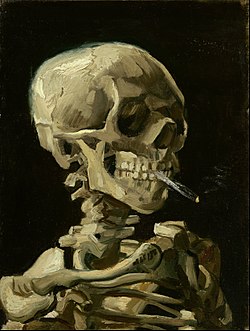
This week I spent a lot of time visiting the Van Gogh Museum online. I was lucky enough to have been there in person two years back. I remembered the "Skeleton smoking a cigar"
I don't know how well known this painting was, but it was new to me at that time. And then I found out that Tamino's song "Cigar" was inspired by this painting. Tamino's concert was the first casualty for me due to the Coronavirus. I had tickets to go see him on March 11th in LA and we decided to cancel in the interest of social distancing.
More than the sunflowers and the irises I remember being struck by Van Gogh's paintings of trees - where he focused not on the top but on the bottom - the roots of trees. I am reading "Underland" by Robert McFarlane and hence I seem more tuned to looking at the understorey
This was one of my favorite Van Gogh paintings. One of my friends went on a forest walk in India a few weeks back and wrote a poignant piece on what the forest meant to him. He talks about the need to slow down to nature's pace to become resilient. Maybe it is just that my brain is looking to make sense of these quarantines and social distancing, but his words seemed to resonate as we've all slowed down these past few weeks and there is no doubt that we have given the Earth a chance to heal. But will we able to heal and recover from this? Only time will tell.
Let me close this random rambling post with a self portrait of the man
The bandaged ear recalls what happened after 60+ days of spending time with Gauguin (only partly kidding). As we are all closeted with our near and dear ones - a friendly reminder to take care of boundaries, not to push each other's buttons and to pay attention to our mental health in unprecedented times like these.
Friday, March 13, 2020
On Privilege
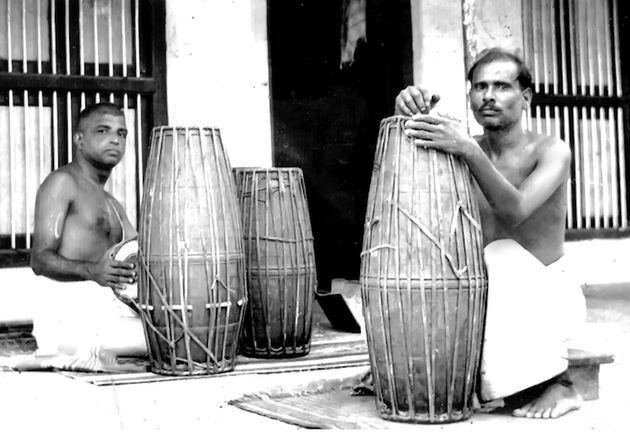
You can ask anyone from India for characteristics that define a Brahmin and I bet vegetarian, cow-lover, classical music connoisseur will show up in a list that may include religious and intellectual. So it is ironic that the Mridangam is a skin instrument that relies on healthy cows (especially female that have given birth to one or two calves) being slaughtered specifically for their skin, a fact that I was ignorant of or perhaps blind to. T.M.Krishna shines as a historian of music and the legwork he has done for this book has taken him to slaughterhouses and into the homes and workplaces of the legendary makers. At the heart of the book is the relationship between Mani Iyer and Parlandu, the artist and the maker, who together changed Mridangam and Carnatic music. However, Parlandu's story is rarely talked about or even known and this book attempts to change that. Although both Mani Iyer and Parlandu are no more, their stories are told through their progeny and students. In giving the "other" a voice, TMK is careful enough to make sure he is only a medium and the only judgements he passes are about the music.
![]() |
| A picture from the book - Mani Iyer and Parlandu |
This is also a book about privilege. There is a quote that is attributed to Chomsky that says "The more privilege you have, the more opportunity you have. The more opportunity you have the more responsibility you have." TMK is not adopting a holier-than-thou attitude in this book. As a man of privilege he is taking that opportunity to understand the sources of his privilege and feels that the whole Carnatic music world has a responsibility towards these makers who need to be not just acknowledged but also celebrated. Cow protection shows up in the Indian constitution and there are many who think that beef eating should be banned in India. However, the classical arts which rely on slaughtering animals especially the cow exposes the hypocrisy of this cow-loving stance.
Personally, this book affected me a lot. As a Brahmin I grew up surrounded by Carnatic music. I was also surrounded by numerous "others" who did not belong to my social class. My parents and even my grandparents were generally very tolerant, but there were so many coded behaviors which were passed along from a place of privilege. There were numerous people in our lives who did not belong to our social strata and on whom we depended on - my mom's rickshaw driver, our maid, the lady who sold flowers, the lady who ironed our clothes, the newspaper recycler, the bicycle repair man, and the watchmen of our colony. My parents showed kindness to them, loaning them money, offering them a cup of coffee or food. My mom would always get down from her rickshaw when in an up slope and would walk next to the puller so as to not burden him unduly. My dad even attended the weddings of a couple of them and was the first to show up to the police station when one of them was wrongly accused of theft by someone else in our community. However the benevolence was often marked with certain class conditioning that both sides followed. They never sat on our couch, never entered our kitchen, always had a separate set of utensils from which they ate or drank and always addressed my parents with respect. I wish i can say I knew each of their names. Unfortunately a few were simply referred to by their professions while they addressed my parents as Sami or Iyer amma. Ironically the lady who ironed our clothes was christened by my brother as a toddler as "Sami" as he thought she was announcing herself when she was really addressing my dad - so in an interesting double twist she became "Sami" (upper class male) at least at our home until the end of her life. When TMK tries to understand who Parlandu truly was he is unable to break down the wall and beyond his technical skills was never able to get to the stories about the man behind the Mridangam. Similarly, I often look back on these people who formed part of my daily life and realize that I never really knew them as the caste barriers cropped up.
This book is an eye-opener on many levels, but especially on a personal level if you grew up in a privileged position. Privilege does not automatically mean a position of financial or political power. On the contrary many Brahmins (including my own family) were not wealthy. There were no ancestral properties. My parents didn't even own a cycle, or great luxuries, relied on public transportation for their entire working career and worked hard to pay off their mortgage. They had little to no influence in the corridors of power. Their votes hardly counted. However, we all grew up with a feeling that our lives and stories and that of our ancestors mattered and that was a feeling that gave us confidence in our future. Decades of Dravidian movement that had an anti-Brahmin policy at its core or an affirmative action policy that tried to shut off Brahmins from public sector jobs or educational institutions had still not significantly dented the cultural cache of the community or the upward movement of the class. The privilege also meant that someone else did our dirty jobs for us - whether that was repairing the sewer of the city or slaughtering a cow for its skin for our precious instrument. Although unchained from the shackles of caste in the US, I realize that I need to be continuously aware of my privilege. TMK's book is a clarion call for awareness more than anything else.