Wednesday, January 11, 2023

Gangai Konda Chozhapuram - A Pinnacle of Prowess

Since my last post a few people have asked me about Kudavayil Balasubramanian. He is a well known scholar and has numerous, very engaging talks on Youtube (in Tamil) that I recommend people watch. Here are the links to some of his best lectures (3 Chola templesRajaraja & Rajendra). The books I have are the following. Most of the information in this blogpost are from his book "Rajendra Chozhan" (middle of the bottom row below).

The books I have - yet to read the one about the Nayaks

Back to my trip report. Although we did Gangai Konda Chozhapuram (GKC) temple (aka Peruvudayar Temple) on the third day I am writing about it before I write about the Big Temple as I am going backward in time. GKC was built by Rajendran I (1012-1044) the son of Rajaraja I (985-1014) and is perhaps the greatest of the Chozha kings. In the Chola tradition the crown prince always ruled alongside his father for a few years and hence the reigns overlap. He expanded the empire and the temple / water works of his father and is famous for sending his general to bring the waters of the Ganga (specifically Hoogly/Bagirati river) from Tribeni in Bengal in golden pots  to bless his new capital and the temple he built at the same location. GKC is about 40 km from Kumbakkonam and 80 km from Tanjavur. 

Rajendra shifted his capital from Tanjavur to GKC almost overnight. GKC at that time was an unpopulated region so the king built a city from the ground up after having blessed it with the waters of the Ganga. Kudavayil has a detailed overview of this shift as documented in a stone inscription. He states that everyone from all walks of life including traders, sculptors etc all immigrated from Tanajvur to GKC.

Let me start with the pictures of the gopurams and vimanam.

First View

The destroyed second Rajagopuram in the front

As you enter the site you see two pillars (not shown in my pictures) which are the remnants of the first Rajagopuram which seems to have been destroyed by the British Public Works Dept back in 1836. As you go through that you see a partially destroyed second Rajagopuram. There is a photograph in the British Library from the 19th century which shows this Second Rajagopuram with 3 levels before it was damaged to its current state.

View of the Vimanam from the Second Rajagopuram

I loved the Bull in this temple! The big black one in the Big Temple was not built by the Cholas. This one also does not seem to be the original (built by a Zamindar). It is built from many stones and covered in what is called as சுதை (Sudhai) which is lime mortar.


 Now for the views of the Vimanam


 Before I go into the sculptures there are two other structures called North Kailayam and South Kailayam. I can't find a picture of the South in my photo roll, but here is the North Kailayam which houses the Goddess known as Brihan Nayaki

North Kailayam - Now the Abode of Brihan Nayaki


There is also a small temple for Durga / Kottravai/ Mahishasuramardhini. I didn't get a picture of the idol as I was not sure if we were allowed to take a picture but she is a sight to behold. Rajendra I got this statue from the Chalukyas and the Goddess has 20 hands. Instead of a Buffalo at her feet to symbolize Mahisha, here he is shown in human form. 

Picture Courtesy: Kudavayil Balasubramian's book "Rajendra Chozhan"


Now let me move onto the sculptures!

According to Kudavayil the move to GKC and the construction of the city and temple necessitated that the sculptures were worked on not just by experts but also by their trainees and novices. While most sculptures show the perfection that one expects from the Middle Chola period, there are some discernible differences in the details and that helps differentiate the expert from the novice. The guardian figures at each entrance show this difference.

Dwara Balaka Figures (Guardian figures similar to Lamassu)

See if you can spot the differences between the R and L figures

I will write a separate note about the guardian figures when I do the post on the Big Temple as I have better pictures. In general the guy on the right points to the direction of God and one can see the story of a snake devouring an elephant at the bottom of the left figure. More on this in the next post.

Gajalakshmi
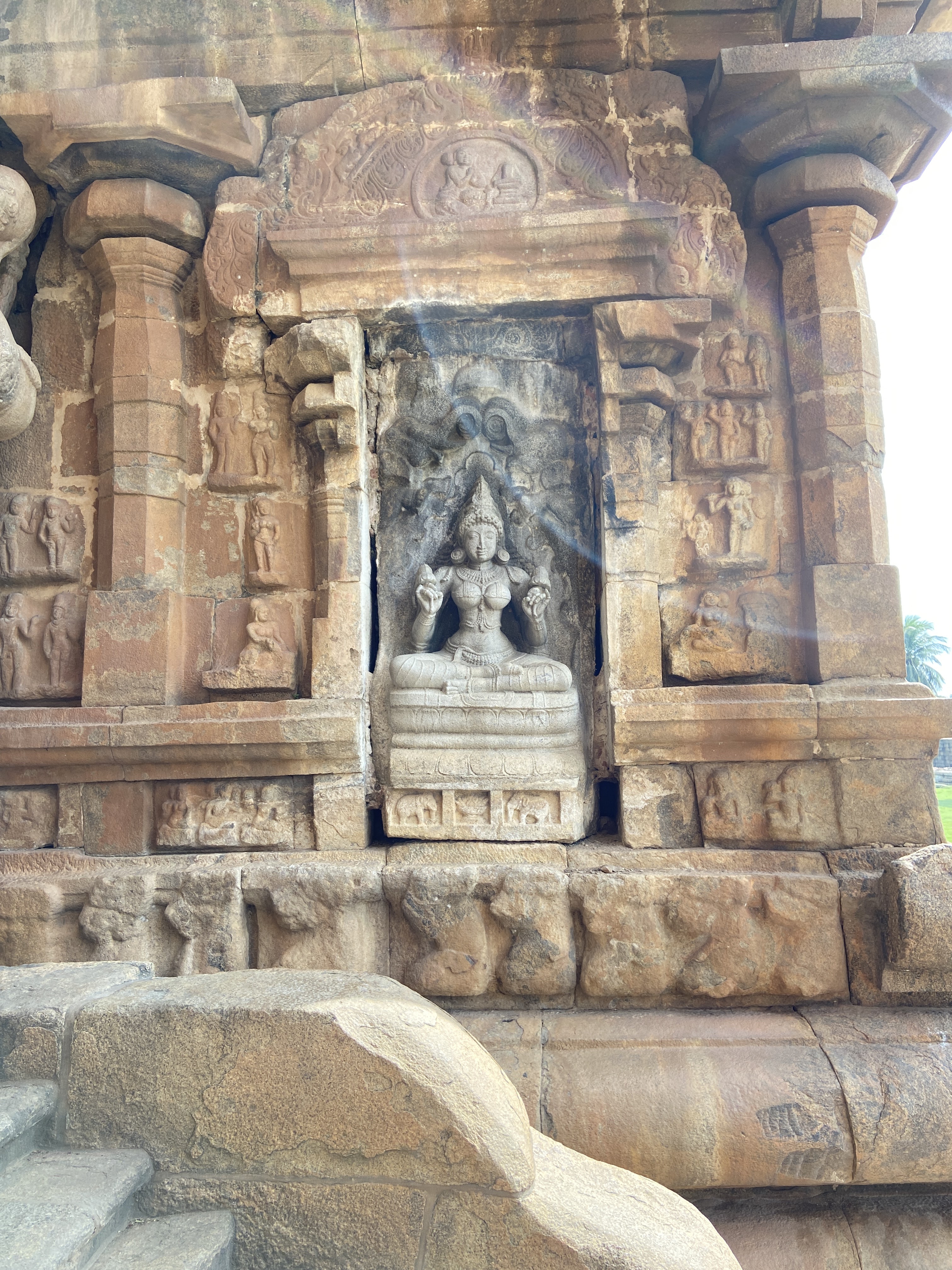
This sculpture is important for many reasons. For one, above the niche you can see the sculpture of Rajendra I worshipping a Shiva Linga and is probably the only image of the king in the temple. I am attaching a close-up here


In addition this form of Lakshmi, with two elephants with their raised trunks showering flowers, Lakshmi with two lotuses in her two hands while seated on a lotus herself has been in sculptural practice in Tamil Nadu for apparently two thousand years and references to this form are found in ancient Sangam literature like Civaka Cintamani

Bikshadanar (The Lord who Begs)
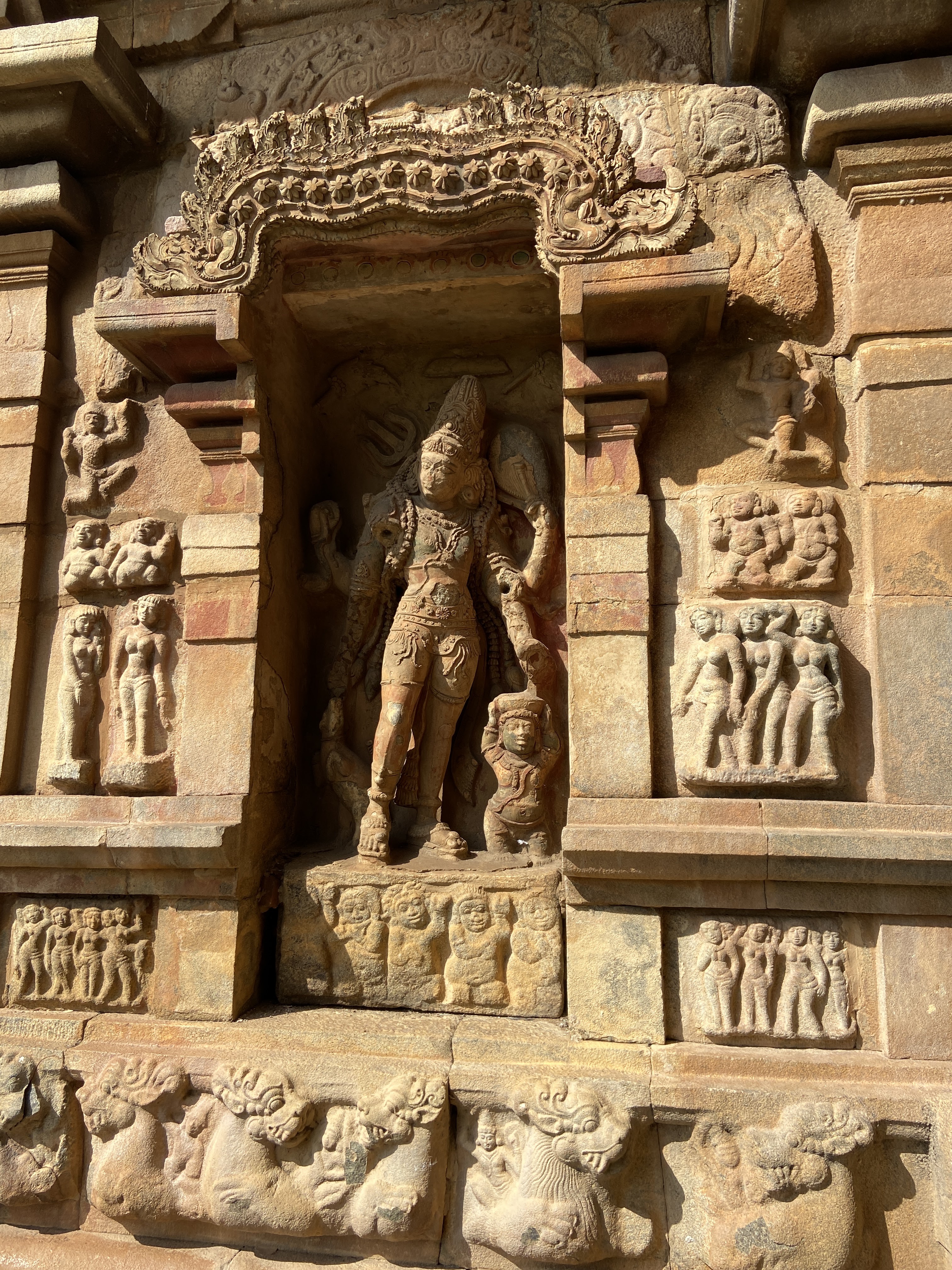

 One can spend hours analyzing this one. I will ask people to read Kudavayil's book on the backstory as to why Shiva took this form and Vishnu took the form of Mohini to teach the sages and their wives a lesson. What is shown here is how the womenfolk are rushing out to see the handsome beggar and feed him (see the sculptures on the side - the bottom row with 2 women on one side and 3 on the other). The sculptures on the side and bottom are original Chola, but the main sculpture has suffered some damage in the past and has been restored with Sudhai but is still seeing some damage. 

Umai Oru Paagan (Ardhanadheeshwar)

This sculpture shows the differences between the male and female side in terms of the clothes, the poses and the body structures beautifully. While Uma holds flowers, Shiva holds weapons.

Dancing Ganapathy

This is another sculpture that was simply joyous to look at as you see Ganesha dancing to the music made by all the Boothaganam (Bhutas) on the side and bottom. If you can zoom to the top of the niche you can see a circular inscription that is not very clear. It should show the sitting lion + two fish + bow (Chola+ Pandya+ Chera) symbol of Rajendra which is seen in coins from that period.

Alangadu Dancer

Perhaps the most famous sculpture of this temple is the one above which shows Shiva dancing joyfully in Alangaadu (Banyan Forest). The Forest is indicated by the carvings of trees above Shiva's head. He is performing this dance at the request of Karaikal Ammai (seen in the bottom row to the left of the 4 sculptures) who is singing for him. Uma is watching her husband dance from the side while the Sun, the Moon and all the Devas and Rishis have gathered on the side. A gentle smile is seen on Shiva's face and in contrast you can see Durga dancing at the bottom right behind Shiva. Unfortunately the sculpture broke at some point and a stone support has been provided to the raised leg. This is the one sculpture that I saw most people actually look up and enjoy at the temple. Kudavayil provides more detailed analysis of the posture, Shiva's accessories etc. One thing he mentions is that this is the only place where the Banyan tree is portrayed as part of the dancing Shiva sculpture and if you look closely you can see a bag hanging from the tree which holds the sacred ash.


Gangadhar


This is one of my favorite sculptures at the temple and I apologize for my very poor picture. I couldn't get another one as it started to rain soon after. The story here should be familiar to most who know the story about how Ganga came to the earth and how Shiva caught her in his locks. While that is seen in the top left corner, the focus of the sculpture is on Uma's jealousy and how Shiva sensuously tries to stop her from leaving him.

Now I am going to do a quick run through of other sculptures

Hari and Haran together in one form

See if you can tell the differences between Hari and Haran based on the clothes and what they hold in their hands.

Vishnu with his consorts

Karthikeya

Shiva bestowing the Chakra to Vishnu - see Vishnu worshipping Shiva on the right side bottom row

Kalakala Moorthy

Kottravai

Brahma with his consorts

Bhairav

Kalaimagal


Here is one final sculpture 

Sandeeshwar being blessed by Shiva


Unfortunately it was very crowded here so I couldn't get a proper picture of the side sculptures. The entire left side is cut off but you can see something of the right side sculptures - especially the cows and an old man kicking the milk bucket. The left side sculptures would have shown the old man hiding in a tree in the top row and a boy hitting the old man in the bottom row. The story is described in Periyapuranam and I am providing a wikipedia link here. If you know the story then you can appreciate the sculptures even more. I especially love how the sculpture showcases Shiva crowning Sandeeshwar with the garland.

I am going to wrap up now as this has already become a bit too long. Of all the three temples I saw, this one was my favorite. Maybe it was because I had read more about this one than the other two and could appreciate what I was seeing having known the backstory. Also, unlike Darasuram which was just an abundance of riches, this one was a bit more measured and so you could actually spend time with each one. Rajendra had been involved in the construction of the Big Temple too, so I believe he knew exactly what he wanted when he worked on GKC. While paying tribute to his father he managed to forge his own identity and has truly left a monument that is a testament to his prowess as a supreme ruler. 


Tuesday, January 10, 2023

Darasuram - Stories in Stone

From the time I read Ponniyin Selvan about 17 years back I have been wanting to go on a tour to Tanjavur and Kumbakkonam and visit some of the magnificent temples built by the Chola kings. While I have been to Tanjavur/ Kumbakkonam many times it was always because of a religious ceremony/ event like when when we had our child's tonsure done for her first birthday etc. This December my brother made it happen for me and we did a 3 day tour of the Big 3 Chola temples, and thanks to my SIL (husband's sister) who sent me many of Kudavayil Balasubramaniam's books on the Cholas I was able to read in advance and prepare myself for the sights. 

We did Darasuram the first day, Periya Kovil (Big Temple) on the second and Gangai Konda Chozhapuram on the third. In addition we made stops at the usual Vaishnavite temples of Uppiliappan, Nachiayar Kovil, Sarangapani etc. We also did a tour of Tiruvaroor for the first time but with only an hour we didn't get a chance to savor the temple. If ever there was a place that seemed steeped in mysticism it was Aroor. I hope to go back especially after reading Kudavayil's book on this temple.

I am going to break the blogpost into 3 as I have many pictures I would like to share and document a bit on each temple and its highlights. This one is going to focus on Darasuram.

Built by Rajaraja II (1146 to 1163 AD), the son of Kulothunga II (1133-1150), Darasuram aka Rajarajeswaram / Airavateeswarar temple was built by this king as a tribute in stone to the works of his teachers Sekkizhar and Ottakkoothar. Steeped in the literature of these amazing poets, the King decided to build a temple similar to his ancestors but depicting scenes from the works of his illustrious teachers. The temple is now recognized as a World Heritage Monument and is a short drive from Kumbakkonam. One can spend all day here if one stopped at every sculpture and analyzed the story behind the carvings. However, I managed to hit only some of the highlights. It would have been amazing to have a good guide who knew both Tamil poetry and the temple well but we couldn't find one. So with only my recollections of Kudavayil's lectures I acted as our guide. Before I write about the sculptures here are a couple of external views of the site.

The East Gopuram (or what remains of it)

The East Gopuram must have had red bricks that seem to have been lost to the ravages of weather and people who didn't realize the importance of the site. But the remaining structure speaks of what would have been a magnificent entrance to the site. You can see the second Gopuram below and it has 3 levels. Kudavayil states that the East Gopuram would have had 7 levels, so you can imagine the east gopuram in all its glory in your mind's eye.

Second Rajagopuram at the entrance


Side View of the Vimanam

Back View of the Vimanam

The main vimanam resembles a chariot and has a number of mandapams, Stone pillars at various mandapams hold the structure together. Surrounding the Vimanam are some of the amazing sculptures in niches. Here are a few.

Shiva as Agoramoorthy with 14 snakes

With 4 heads facing 4 directions and snakes all over this is one of the dances of Shiva and unlike the Anandatandavam (Happy Dance) when he has only 1 snake, this one features 14.

Sarabamoorthy - Shiva as a Lion with 8 legs and wings ending the Narasimha Avatar


There is a small temple for Sarabamoorthy. While not exactly a gryphon, this avatar of Shiva shows him as an eight-legged lion with wings. Following Narasimha's slaying of the asura Hiranya, the anger of Narasimha had not abated and he was wreaking havoc. So it is said that Shiva took the form of Sarabamoorthy and quelled Narasimha to save the world from his anger. If you look closely you can see the Devas in the heaven, and at the bottom the conch and chakra are falling towards the earth indicating that the Saraba is carrying Narasimha to the heavens. Unfortunately the white cloth hides the wings of the Saraba.

Arjuna fighting Shiva the Hunter for a wild boar and gaining Shiva's favor

The story of Arjuna winning the Pashupatastra is told in the form of a narrative sculpture above. You can see Arjuna doing penance in the bottom row; The row above shows Arjuna fighting Shiva as the Hunter; the third row from below depicts Arjuna surrendering and the top row shows Shiva revealing his true identity.

Lingothbhava Moorthy - with Brahma & Vishnu on either side

The above sculpture shows the story of the dispute between Brahma and Vishnu regarding who was the greatest when a Linga appears in front of them. Vishnu seeks the bottom in the form of a boar while Brahma takes the form of a swan and seeks the top. When both fail, they recognize the endless linga to be Shiva and give up their pride. You can see the boar and the swan in the main sculpture with Brahma and Vishnu on either side as mini-sculptures.

Mahishasuramarthini (Kottravai)

Ravana  

Another narrative sculpture of interest is the story of Ravana lifting Mount Kailasa. Reading from the bottom to the top one can see Ravana's chariot parked to the side as he is unable to cross the mountain and is therefore lifting it. One the next level you can see monkeys, deer and other animals and also Indra and other sages. The third level shows Uma holding onto Shiva as the mountain shakes and finally Ravana bowing to Shiva and Uma while Shiva is ready to bestow a sword.

Shiva as Bhairava

AdhiSandiKeshwarar


More beautiful black-stone sculptures are seen along the niches of the main Vimanam. I took only a few pictures which I have posted above.

I haven't read Periyapuranam since I left high school many decades ago and I couldn't recollect everything Kudavayil had written about. But I went looking for the series of sculptures where the Saint Appar sings to the birds and beasts (kinda like St.Francis for those familiar with how he is depicted in Western art). I was especially looking for a sculpture showing Appar singing to the bird referred to in Tamil as "Magandril". Most tamilians have heard of the bird called "Andril" which only now I realize is from the Ibis family. The Andril is often used in Tamil poetry to depict faithfulness as it is a monogamous bird. I have not been able to figure out what bird is the "Magandril" - could it be a flamingo? In any case I was having a hard time locating the sculpture when I finally asked the Priest at the temple who kindly led my brother and I to the exact location. Here are those sculptures!

Appar singing to the "Magandril" - the next set of birds are peacocks


Another famous story depicted in almost all Chola temples is Rama killing the monkey Vali thus aiding his brother Sugreeva to ascend the throne. I appreciated how intertwined the legs of the two monkeys are as they wrestle each other.

Rama killing Vali

Another two-part narrative sculpture depicts the story of Shiva destroying Lord Kama (Lord of Love). Read from right to left you can see Shiva meditating and Kama aiming his bow and arrow at him. The next part shows Kama fallen and his wife Rathi begging the Lord's forgiveness.

Shiva reducing Kama to ashes


The king was obviously a lover of dance and music as seen by the number of sculptures devoted to music and dance. I don't have a whole lot of pictures as I didn't want to spend all my time looking through my phone. But there was one sculpture of a pregnant woman being assisted by midwives that was quite amazing. So here it is

Pregnant women being assisted

You can see the doctor approaching the pregnant woman with a medicinal bottle of some sort. The temple was not just for depicting stories from scriptures but everyday life too!

One can also spend a lot of time just admiring each entryway and the decoration of the stairs. Elephants are mostly used but you can also see sculptures of lions devouring elephants. Here are a few samples


I am going to stop here as I can go on and on. The place is a treasure trove and if one knew the stories from Periyapuranam, Kandapuranam, Ramayana, Mahabharata, then one can spend a lifetime here savoring each and every stone. I didn't touch upon the paintings from the Nayak period as I don't know much about that time period and I am yet to read about that.

Overall Darasuram was a once-in-a-lifetime experience. I am greatly indebted to the historian Kudavayil Balasubramanian for his books and lectures on Tamil heritage sites. Discovering his works has been one of the highlights of 2022 for me. I wish the authorities would do more to protect this temple from vandalism and misuse. For a comparison the gothic cathedrals of France like Saint Denis (1140s?) were built around the same time and Darasuram deserves to stand alongside such famous cathedrals. I wish there were signposts at all the main sculptures informing visitors about what they were seeing. I thought someone with enterprise would sell pamphlets or books about the site near the site. Very little information was available and there was no easy way to hire qualified guides. I wish I had taken my copy of Kudavayil's book with me, but I hope to go again sometime in the future and will check out all the other sculptures I missed.


Tuesday, November 29, 2022

A Week Amongst Birds

During the peak of the pandemic whenever I got Zoom fatigue I would take a break by checking out the livestreamed Feedercams set up by the Cornell Lab of Ornithology. One such feeder was from the Canopy Lodge in Panama. So while we were tossing around the idea of actually traveling for thanksgiving I proposed the Lodge and my daughter jumped at it. My husband is game for anything and although he can't tell Bird A from Bird B he is always happy to tag along. 

Canopy Lodge

The famous Panama Cam Feeder - this time in person!

Birding trips are not relaxing in the traditional sense of a holiday and this was no exception. Breakfast was usually at 6 or 6:30 and we were off to the woods by 7/7:30 am. Come back for lunch around 12:30. Head out again at 2:30 and back by 6 pm. Checklist at 6:30 pm, dinner at 7 and bed at 8:30/9. Rinse and repeat 5 times. That summed up our week in Panama. It involved a lot of standing, quietly at that, sometimes I daresay with full bladders, and staring into bushes trying to detect movement. Our guides were magicians who seemed to possess superhuman abilities to differentiate between the 50 shades of brown/green all hiding within another 50 shades of brown/green and within milliseconds of spotting - recognizing the bird! By Day 3 some of that magic started rubbing on us a teensy bit and my daughter and I picked up a few skills and were able to recognize the bigger species and a few commonly occurring thrushes, kingbirds and other flycatchers.

Besides the birds, the birders are also an interesting bunch. There are many types of birders and one is bound to encounter a few specimens in such a trip. The photographers, who along with their equipment look like Arnold from the poster for the movie The Predator-sin muscles of course. To these folks a bird is not seen unless it has been captured through their lens. There are the hardcore lifelisters who have a goal of increasing their lifelist of species and will be willing to wait for any amount of time for the manakin or warbler to show up so they can check it off their lifelist. It is a numbers game for them and some actually feel that we should be out by 5am as after all the early bird gets, well, the bird.  Then there are those who have converted to birding recently and have the zeal of the convert which can be a little irritating especially as they hog the spotting scope. And some are simply there to see what they can see and that's that. They are more naturalists than birders and enjoy all the nature around them.

Where do we (my daughter and I) fall? Well, we do keep an ebird list, but we don't have a lifelist goal - we just wanted to stumble upon the birds, see some new species, if possible see their behaviors in their natural environment and in that process learn something about the birds and ourselves. So at times, we wanted to move on when the manakin didn't show up or didn't care if we couldn't tell if the warbler we saw was the chestnut-capped or chestnut-sided. My husband was totally having fun as he didn't care about eBird, lifelist, bird id - if he saw a cool bird that was great, and if he managed to get a picture that was even better! He just enjoyed being out there listening to the bird song, the noises of the forest and the changes in weather. No FOMO, no pressure!

In Birding Uniform and Gear :)

I was asking the guides about the local birding scene and they told me that it was not much, although now there is an effort to introduce school kids to the bountiful wildlife in their country. By now the locals are very familiar with the migrant birders who swoop down to the lodge during the birding season, all clad in drab grays and greens, sporting rain gear, their binoculars around their necks, and standing sometimes on the roadside peering up among the trees. We must seem like a weird cult to them.

Spectacled Owl

Overall it was a fabulous trip! While it is true that we saw 140 species of which a 100 were lifers for us, it was not the quantity but the quality of the experience that made it memorable for us. Walking into the woods to see the spectacled and mottled owl was an unforgettable experience. As we stood in the slush in complete silence peering at these magnificent birds we felt like we were invited into their world for a brief moment.  A Rufous-Vented Ground Cuckoo became the star of the week. This bird is so shy that it has one of the fewest observations on eBird and we were lucky to bump into a pair that stood in front of us for 10 long minutes foraging, or as the guides say "working in those bushes." 

Rufous-Vented Ground Cuckoo

We had tried to see manakins in the past in other countries but finally saw the Golden-Collared in Panama. These guys are legendary dancers and although we didn't see him dance we heard his clicking rhythm and saw him and his mate in the forest floor. We followed antbirds just like they follow army ants and although they were too quick for the scope or the camera we managed to catch a glimpse with our eyes. For the first four days we saw one lonely keel billed toucan fly above and then stumbled into a dozen on our last day! 

Keel Billed Toucans

One day when we had wrapped up the day's birding and were walking back to the van, my husband the straggler, who is always taking pano shots on his Blackberry (yes, he still has one of those!), came across a bird which had eluded all of us. The rest of us who went ahead were ready to leave so my daughter went back to get him and saw him photographing a mystery bird. When she alerted all of us, there was a mad rush to go back and sure enough he had stumbled upon the Long-Tailed Tyrant which made the life list for everyone in the group! He was beaming as everyone thanked him for the "nice find."

Long-Tailed Tyrant

Another time after an all day birding session we were returning to our rooms, ready to dash through the last 100 yards from the parking lot all swearing that we will not stop for another bird and sure enough my daughter spotted a Rufous-Crowned Motmot which was the first time we saw one and once again we stopped. How could you not when you see this being appear suddenly in your field of view!

Rufous Crowned Motmot

This basically is the joy of birding - just walking into a space not knowing who is out there and finding someone "working".

 I am normally a walking clock, I have everything timed and am always on a schedule getting from point A to point B. Birding is the only activity that has made me slow down and pause and take notice of things around me. I don't have to go to Panama to experience this. On our nightly walks there have been many times when an owl has surprised us. Just hearing the great horned would make my daughter and I pause and look around and occasionally he/she would grace us with their presence by flying past us. Those are magical moments! Birding has not only given me a renewed sense of why conservation is important and why habitats need to be protected but has also made me more aware of the everyday happiness hidden among trees and bushes in these uncertain times.


Saturday, October 1, 2022

Ponniyin Selvan - Immediate Impressions

Watched PS-1 last night with the family and a whole lot of other Indians. My thanks to all the others who showed up as they gave my daughter (whose first Indian movie was last night) a tease of what it means to watch an Indian movie with Indians in the theater and she had so much fun with the random whistles and cheers all around!

If you had read my preview you know two things 1) I am a fan of the book 2) I am not a fan of Maniratnam. But with PS-1, I am happy to say that Maniratnam delivered what he intended to! The movie gets a B+ / A- from me.

For fans of the book:

If you went looking for the book, just note that it is there as a backbone in terms of overall plot but keep in mind the movie is trying to achieve the impossible - condensing 5 volumes into 2 movies - and therefore has made a few character / script choices. However, those who read the books are at an advantage because they understand what's happening with all the fast transitions. I overheard a few people at the end of the movie saying they didn't quite follow what happened in the second half - hopefully this will lead them to the books in which case it is a win-win!

What I liked:

  • Screenplay  - Jeyamohan triumphs in distilling the essence of the first two volumes to one movie
  • Production values - set design, costumes were excellent
  • Acting - almost all of these actors did their parts well! There were one or two weak performances but overall I was not disappointed with Vanthiyadevan, Nandini, Aditya Karikalan, and Azhwarkadiyaan. I have never seen any Karthi movies and he gets full points for capturing the essence of Vanthiyadevan's comedic sensibilities and the chemistry with Jeyaram works!
  • Opening number - I was not a fan of the Ponni Nadhi song because I didn't like the enunciation choices ARR made, but seeing it on screen overlaid with visuals was much better.
  • Graphics choices - nothing unnecessary or too artificial. The ships were well done (maybe modeled after Borbudur) and battle scenes were choreographed really well!
  • Song incorporation - they didn't have all the songs full length and were quite neatly incorporated in the background.
  • Srilanka scenes were well done visually! 

Misses:

  • Rapid transitions - there was no room for character development given the pace of the movie. I understand that they had to make certain cuts to condense the 2 books into 1 movie, still scenes with Kudandai Josiyar, Kandanamaaran, Idumbankaari helped us get to know Vanthiyadevan, Azhwarkadiyaan better in the books. There was no room for that in the movie. Poonghuzali was a disappointment. Vanthiyadevan's encounter with Poonghuzali and asking her about Senthan Amuthan is out of the blue if you've not read the book! I compare it to LOTR where the movies still allowed us to see the multi-dimensional character of Frodo, Samwise and Aragorn - that was lacking. Also because of the pace and transitions some viewers felt lost in the second half
  • BGM - I know people are going to say that i am just a fan of Illayaraja and will not accept ARR's score, but this was a weak link IMO. With the focus on making a pan-Indian adventure movie, there was a lack of local feel in the background score. Fight scenes were just standard orchestrations with loud score. 
  • Sound quality - why was everything so loud!!! Just blasting the sound straight on for 3 hours hurt my ears!
  • Some key characters are missing or minimized - Kandanmaaran comes to mind. I was expecting a lot more from the secret tunnel scenes and while Devralan aattam did not disappoint, the tunnel scenes did - both in terms of content and the set. This makes me wonder if Manimegalai will show in part 2
  • The beauty of the land was not fully captured. They could have done something simple like using Kamal's voice over to show us the land in addition to the history
  • Unnecessary departures from the book which can irritate fans of the book - but I can forgive some of those choices.

Final Thoughts:

My daughter said it best when she described the movie as an epic fantasy and not a piece of historic fiction. If you went in with that mindset then the choices made make more sense and the appeal to a pan-indian audience is justified. Ideally I would have loved it if they hadn't strayed from the book, but I am OK with most of the departures except a few critical ones, but I will reserve judgement until I see PS-2. The BGM could have elevated the movie to a different level but it made easy choices by going for epic orchestrations and severed itself from the land on which the history is based.  

Having said all these, hats off to Maniratnam for having pulled this off! As a fan of the books I was waiting for an adaptation and he delivers his take on it and manages to appeal to a wide range of people. Ideally the only way the books can be brought to life at the pace we want is if Netflix or Amazon commissioned a 10 part series with each part running for 90 mins. But last night for about 3 hours I was happy to share my favorite book with countless others who had never read it and are now curious about it. That is perhaps the main achievement of the movie!