Since my last post a few people have asked me about Kudavayil Balasubramanian. He is a well known scholar and has numerous, very engaging talks on Youtube (in Tamil) that I recommend people watch. Here are the links to some of his best lectures (3 Chola temples, Rajaraja & Rajendra). The books I have are the following. Most of the information in this blogpost are from his book "Rajendra Chozhan" (middle of the bottom row below).
 |
| The books I have - yet to read the one about the Nayaks |
Back to my trip report. Although we did Gangai Konda Chozhapuram (GKC) temple (aka Peruvudayar Temple) on the third day I am writing about it before I write about the Big Temple as I am going backward in time. GKC was built by Rajendran I (1012-1044) the son of Rajaraja I (985-1014) and is perhaps the greatest of the Chozha kings. In the Chola tradition the crown prince always ruled alongside his father for a few years and hence the reigns overlap. He expanded the empire and the temple / water works of his father and is famous for sending his general to bring the waters of the Ganga (specifically Hoogly/Bagirati river) from Tribeni in Bengal in golden pots to bless his new capital and the temple he built at the same location. GKC is about 40 km from Kumbakkonam and 80 km from Tanjavur.
Rajendra shifted his capital from Tanjavur to GKC almost overnight. GKC at that time was an unpopulated region so the king built a city from the ground up after having blessed it with the waters of the Ganga. Kudavayil has a detailed overview of this shift as documented in a stone inscription. He states that everyone from all walks of life including traders, sculptors etc all immigrated from Tanajvur to GKC.
Let me start with the pictures of the gopurams and vimanam.
 |
| First View |
 |
| The destroyed second Rajagopuram in the front |
As you enter the site you see two pillars (not shown in my pictures) which are the remnants of the first Rajagopuram which seems to have been destroyed by the British Public Works Dept back in 1836. As you go through that you see a partially destroyed second Rajagopuram. There is a photograph in the British Library from the 19th century which shows this Second Rajagopuram with 3 levels before it was damaged to its current state.
 | |
| View of the Vimanam from the Second Rajagopuram |
I loved the Bull in this temple! The big black one in the Big Temple was not built by the Cholas. This one also does not seem to be the original (built by a Zamindar). It is built from many stones and covered in what is called as சுதை (Sudhai) which is lime mortar.


Now for the views of the Vimanam


Before I go into the sculptures there are two other structures called North Kailayam and South Kailayam. I can't find a picture of the South in my photo roll, but here is the North Kailayam which houses the Goddess known as Brihan Nayaki
 |
| North Kailayam - Now the Abode of Brihan Nayaki |
There is also a small temple for Durga / Kottravai/ Mahishasuramardhini. I didn't get a picture of the idol as I was not sure if we were allowed to take a picture but she is a sight to behold. Rajendra I got this statue from the Chalukyas and the Goddess has 20 hands. Instead of a Buffalo at her feet to symbolize Mahisha, here he is shown in human form.
 |
| Picture Courtesy: Kudavayil Balasubramian's book "Rajendra Chozhan" |
Now let me move onto the sculptures!
According to Kudavayil the move to GKC and the construction of the city and temple necessitated that the sculptures were worked on not just by experts but also by their trainees and novices. While most sculptures show the perfection that one expects from the Middle Chola period, there are some discernible differences in the details and that helps differentiate the expert from the novice. The guardian figures at each entrance show this difference.
Dwara Balaka Figures (Guardian figures similar to Lamassu)
 |
| See if you can spot the differences between the R and L figures |
I will write a separate note about the guardian figures when I do the post on the Big Temple as I have better pictures. In general the guy on the right points to the direction of God and one can see the story of a snake devouring an elephant at the bottom of the left figure. More on this in the next post.
Gajalakshmi
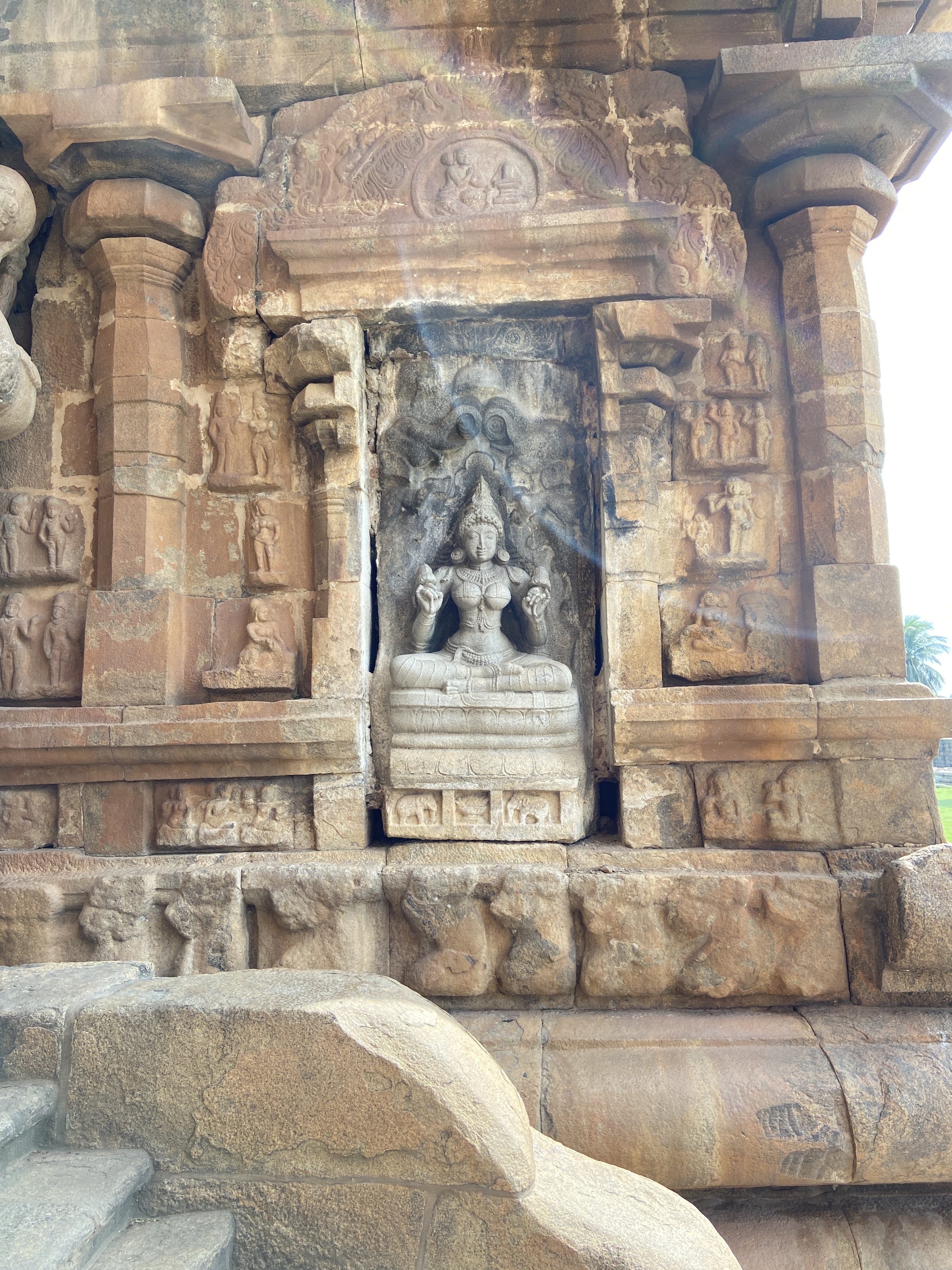
This sculpture is important for many reasons. For one, above the niche you can see the sculpture of Rajendra I worshipping a Shiva Linga and is probably the only image of the king in the temple. I am attaching a close-up here

In addition this form of Lakshmi, with two elephants with their raised trunks showering flowers, Lakshmi with two lotuses in her two hands while seated on a lotus herself has been in sculptural practice in Tamil Nadu for apparently two thousand years and references to this form are found in ancient Sangam literature like Civaka Cintamani
Bikshadanar (The Lord who Begs)
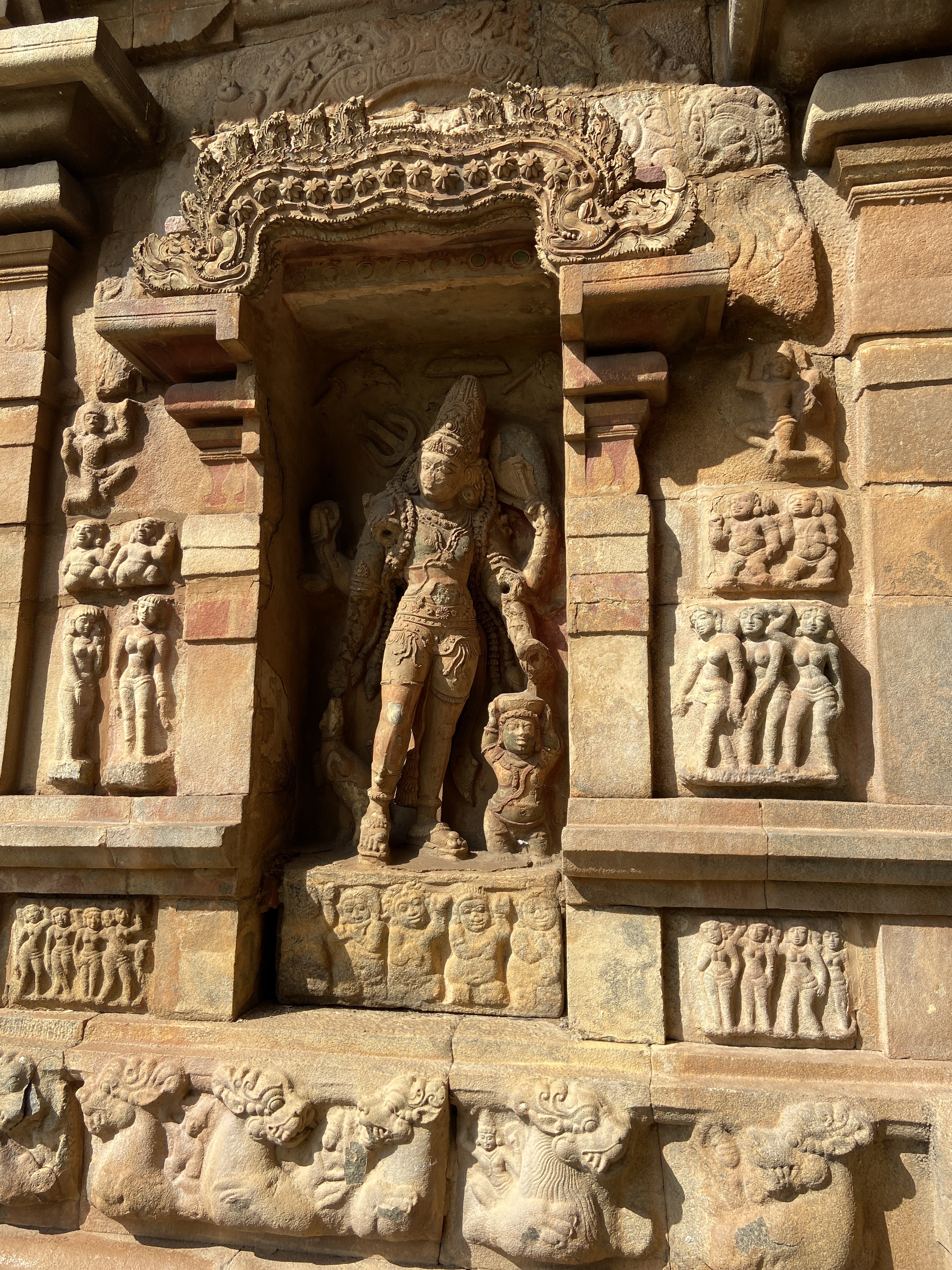
One can spend hours analyzing this one. I will ask people to read Kudavayil's book on the backstory as to why Shiva took this form and Vishnu took the form of Mohini to teach the sages and their wives a lesson. What is shown here is how the womenfolk are rushing out to see the handsome beggar and feed him (see the sculptures on the side - the bottom row with 2 women on one side and 3 on the other). The sculptures on the side and bottom are original Chola, but the main sculpture has suffered some damage in the past and has been restored with Sudhai but is still seeing some damage.
Umai Oru Paagan (Ardhanadheeshwar)

This sculpture shows the differences between the male and female side in terms of the clothes, the poses and the body structures beautifully. While Uma holds flowers, Shiva holds weapons.
 |
| Dancing Ganapathy |
This is another sculpture that was simply joyous to look at as you see Ganesha dancing to the music made by all the Boothaganam (Bhutas) on the side and bottom. If you can zoom to the top of the niche you can see a circular inscription that is not very clear. It should show the sitting lion + two fish + bow (Chola+ Pandya+ Chera) symbol of Rajendra which is seen in coins from that period.
 |
| Alangadu Dancer |
Perhaps the most famous sculpture of this temple is the one above which shows Shiva dancing joyfully in Alangaadu (Banyan Forest). The Forest is indicated by the carvings of trees above Shiva's head. He is performing this dance at the request of Karaikal Ammai (seen in the bottom row to the left of the 4 sculptures) who is singing for him. Uma is watching her husband dance from the side while the Sun, the Moon and all the Devas and Rishis have gathered on the side. A gentle smile is seen on Shiva's face and in contrast you can see Durga dancing at the bottom right behind Shiva. Unfortunately the sculpture broke at some point and a stone support has been provided to the raised leg. This is the one sculpture that I saw most people actually look up and enjoy at the temple. Kudavayil provides more detailed analysis of the posture, Shiva's accessories etc. One thing he mentions is that this is the only place where the Banyan tree is portrayed as part of the dancing Shiva sculpture and if you look closely you can see a bag hanging from the tree which holds the sacred ash.

 |
| Gangadhar |
This is one of my favorite sculptures at the temple and I apologize for my very poor picture. I couldn't get another one as it started to rain soon after. The story here should be familiar to most who know the story about how Ganga came to the earth and how Shiva caught her in his locks. While that is seen in the top left corner, the focus of the sculpture is on Uma's jealousy and how Shiva sensuously tries to stop her from leaving him.
Now I am going to do a quick run through of other sculptures
 |
| Hari and Haran together in one form |
See if you can tell the differences between Hari and Haran based on the clothes and what they hold in their hands.
 |
| Vishnu with his consorts |
 |
| Karthikeya |
 |
| Shiva bestowing the Chakra to Vishnu - see Vishnu worshipping Shiva on the right side bottom row |
 |
| Kalakala Moorthy |
 |
| Kottravai |
 |
| Brahma with his consorts |
 |
| Bhairav |
 |
| Kalaimagal |
Here is one final sculpture
 |
| Sandeeshwar being blessed by Shiva |
Unfortunately it was very crowded here so I couldn't get a proper picture of the side sculptures. The entire left side is cut off but you can see something of the right side sculptures - especially the cows and an old man kicking the milk bucket. The left side sculptures would have shown the old man hiding in a tree in the top row and a boy hitting the old man in the bottom row. The story is described in Periyapuranam and I am providing a wikipedia link here. If you know the story then you can appreciate the sculptures even more. I especially love how the sculpture showcases Shiva crowning Sandeeshwar with the garland.
I am going to wrap up now as this has already become a bit too long. Of all the three temples I saw, this one was my favorite. Maybe it was because I had read more about this one than the other two and could appreciate what I was seeing having known the backstory. Also, unlike Darasuram which was just an abundance of riches, this one was a bit more measured and so you could actually spend time with each one. Rajendra had been involved in the construction of the Big Temple too, so I believe he knew exactly what he wanted when he worked on GKC. While paying tribute to his father he managed to forge his own identity and has truly left a monument that is a testament to his prowess as a supreme ruler.


