Looking back on the 30+ countries I've completed, I realized that most of the stories are not necessarily what one can call as "light reading". War, Genocide, Poverty, Colonialism all form the undercurrent for many of the stories. Cambodia is no exception.
"First they killed my father" is the moving autobiography of Loung Ung who survived the killing fields of Cambodia, and moved on to become an advocate against violence for the UN. What is powerful about this story is how a 5 year old can dig deep within herself and find strength to survive brutality, hunger, and tragedy in the midst of absolute despair.
Under the Khmer Rouge millions of urban residents were forcefully "relocated" to rural Cambodia in an attempt to rid the country of loyalists to the previous Government. Urban dwellers were also viewed with suspicion as they were deemed to be "polluted" with capitalistic ideas. Walking for 8 days from the capital Phnom Penh Loung's family seeks refuge in one camp after the other, hiding their identity (Loung's father worked for the previous Government). The family gets separated and unfortunately not all of them survive - losing her dad, her oldest sister and her mother and her baby sister, it was a miracle that Loung survived.
Her experiences as a child soldier in the work camps, witnessing of the execution of a Khmer Rouge soldier, escaping rape, narrowly escaping death from hunger, infections and bullets, working in leach infected waters - makes you wonder how can a child ever recover from these harrowing experiences. Finally reuniting with her surviving siblings, she escapes to Thailand with her oldest brother - Meng and his wife Eang and from there gets a ticket to the US as a refugee.
Throughout the 5 years under the Khmer Rouge she and her sister Chou faced similar atrocities and being of different temperaments they each coped in their own way. Leaving Chou behind in Cambodia, must've been overwhelming for Loung as she must've been consumed by guilt. I believe this prompted her to write her second book "The Lucky Child".
While the book is a story of the victims of the Pol Pot regime it is still very much a story of a survivor and is one of hope. This is a story of someone who has overcome the childhood scars and survived in an alien nation and then made their life one of purpose. To think that all these happened not too long ago only shows the need for the world to learn more from these stories and makes one more appreciative of Loung's role in the campaign against landmines.
As a small aside: I wanted to read more about how Loung wrote this book as she could not have possibly remembered every small detail as she was 5 years old at the beginning of the invasion and was only 9 or 10 when she moved to the US. I am no psychologist, but wouldn't blocking these memories out be one of the chief ways of coping or were the scars too much that even a child that young remembers and recollects everything that happened? I don't know. Hey at 5, or even 9 my biggest concern was getting through school and the only violence i had experienced was the simulated ones on some badly made Tamil movies ! How can I even pretend to understand what she must've gone through!
Wednesday, May 19, 2010
Friday, May 14, 2010
OBOC - Cameroon
"Mission Accomplished"... before you think I am doing a George Bush by declaring victory in OBOC a bit prematurely (I still have 100 odd countries to go, and I only hope it won't last as long as the Iraq war!)... I am just referring to Mongo Beti's comic novel "Mission terminee" which I read in English as "Mission Accomplished".
Despite failing his Baccalaureat exam in the "best tradition", Jean Marie Medza is charged with an all important duty as a messenger to the remote village of Kala, to bring back the wife of a relative, Niam, who had fled her husband's home unable to bear his abusiveness. Going to Kala on a bicycle with nervous apprehension, our hero is pleasantly surprised by the welcome he receives at his uncle's home, and the friendly warmth of his cousin Zambo only to discover that the object of his mission has run away from her father's home with another man. Forced to spend many days at Kala, he receives the attention of everyone in the village as the only town-boy amidst the country folk who was educated by the white man. Compared to the abuse he suffers at his father's hands, Medza finds himself being elevated to a demi-God status in the village and for the first time forms a great friendship with other boys of his own age thanks to Zambo and his friend.
What starts out as a comical adventure, turns about to be a coming of age story of Medza, where he develops a deeper understanding of himself, his culture and the "colonized African". At the end of his journey, he finally stands up to his father but is forced to leave his home and his young wife. He summarizes his entire understanding in light of his experience in the following words "the tragedy our nation is suffering today is that of a man left to his own devices in a world which does not belong to him, which he has not made and does not understand. it is the tragedy of man without an intellectual direction, a man walking blindly through the dark in some hostile city like New York....How will he solve the intricacies of a subway map or know where to change trains?"
Besides the comical nature of the story, I loved Mongo Beti's sketches of the lead characters, Medza, Zambo and Medza's father ("living example of the astonishing results that can occur when Western hypocrisy and commercial materialism are grafted onto a first-rate African intelligence") in particular. Also the seemingly pointless jocular ramblings that Medza had with the villagers of Kala were also very revealing - what did Colonization, Constitution, Law, Capitalism, Communism mean to people flung in remote corners of Cameroon?What does it say about Medza, who finally escapes the tyranny of his father, while at the same time benefiting from the education he received, but never comes back for his wife? How does he resolve the conflict between his heart and his mind? Is this the dilemma the educated elite of Africa (or for that matter, any colonized developing country) face?
Wikipedia tells me that the book received praise for its realism and criticism from the likes of Chinua Achebe for romanticizing the past. To me, it was one of those books which appear very easy to read, with farcical situations, but actually have a few layers if one cares to look.
Despite failing his Baccalaureat exam in the "best tradition", Jean Marie Medza is charged with an all important duty as a messenger to the remote village of Kala, to bring back the wife of a relative, Niam, who had fled her husband's home unable to bear his abusiveness. Going to Kala on a bicycle with nervous apprehension, our hero is pleasantly surprised by the welcome he receives at his uncle's home, and the friendly warmth of his cousin Zambo only to discover that the object of his mission has run away from her father's home with another man. Forced to spend many days at Kala, he receives the attention of everyone in the village as the only town-boy amidst the country folk who was educated by the white man. Compared to the abuse he suffers at his father's hands, Medza finds himself being elevated to a demi-God status in the village and for the first time forms a great friendship with other boys of his own age thanks to Zambo and his friend.
What starts out as a comical adventure, turns about to be a coming of age story of Medza, where he develops a deeper understanding of himself, his culture and the "colonized African". At the end of his journey, he finally stands up to his father but is forced to leave his home and his young wife. He summarizes his entire understanding in light of his experience in the following words "the tragedy our nation is suffering today is that of a man left to his own devices in a world which does not belong to him, which he has not made and does not understand. it is the tragedy of man without an intellectual direction, a man walking blindly through the dark in some hostile city like New York....How will he solve the intricacies of a subway map or know where to change trains?"
Besides the comical nature of the story, I loved Mongo Beti's sketches of the lead characters, Medza, Zambo and Medza's father ("living example of the astonishing results that can occur when Western hypocrisy and commercial materialism are grafted onto a first-rate African intelligence") in particular. Also the seemingly pointless jocular ramblings that Medza had with the villagers of Kala were also very revealing - what did Colonization, Constitution, Law, Capitalism, Communism mean to people flung in remote corners of Cameroon?What does it say about Medza, who finally escapes the tyranny of his father, while at the same time benefiting from the education he received, but never comes back for his wife? How does he resolve the conflict between his heart and his mind? Is this the dilemma the educated elite of Africa (or for that matter, any colonized developing country) face?
Wikipedia tells me that the book received praise for its realism and criticism from the likes of Chinua Achebe for romanticizing the past. To me, it was one of those books which appear very easy to read, with farcical situations, but actually have a few layers if one cares to look.
Tuesday, May 4, 2010
OBOC - Burundi
Everyone, well almost everyone, has heard of the Rwandan genocide and know that it had something to do with ethnic tensions between Hutus and Tutsis. But until I read "The voice in my heart" by Gilbert Tuhabonye I had no idea how the Rwandan conflict was closely tied to the political history of Burundi and the 2 clashes of genocidal proportions that took place in Burundi in the early '70s and '90s.
Here is a brief primer if you are interested, else skip to the next paragraph. (This does not figure in the story of Gilbert, but is a good-to-know background). In a country of Hutu majority (>80%), the Tutsis have held power and senior positions in the Military and Government since Independence. In the first post-independence elections despite a sweeping Hutu victory, a Tutsi was appointed the Prime Minister and this led to a failed coup attempt which was followed by Hutu insurgents killing Tutsis and the Tutsi controlled military retaliating with a systematic slaughter. This also led to many Hutus fleeing to Rwanda resulting in radicalization of the overall Hutu population in Rwanda. This was the infamous first Burundian genocide.
Gilbert's story happens in the '90s when the first Hutu President Ndadaye was assassinated during the second genocide. What followed was a Hutu retaliation on the Tutsi population and the subsequent crackdown by the army. Gilbert growing up in an idyllic village in Mount Fuku in Bururi was at that time attending middle school in the prestigious Lycie Kimbee area, where he had already established himself as a super star athlete. When the Hutu population rounded up the Tutsi students and hacked some of them to death, and set fire to the remaining, Gilbert was the only one who miraculously survived the slaughter. Using the burned bodies of his schoolmates as a shelter and a human bone to break open the window, Gilbert escapes and is eventually picked up the army where he is treated for his burns. Slowly regaining his strength - physical and mental, he does not give up on his dream to go to the US on a track scholarship. Despite the harrowing experiences, his faith in god and the kindness of people around helps him heal and achieve his dreams.
Gilbert's biography - his childhood days, his family, the education system in Burundi and his athletic feats are interwoven with the slaughter episode at the school in alternate chapters. This is an interesting piece of writing and takes the reader from the idyllic childhood spent chasing cows, to the horrific incidents of that day in a swing of emotions. I also found the comparison to Bosnia interesting given that it was around the same time when the genocide was happening there.
I especially liked the description of his simple, yet peaceful life in Mount Fuku. Childhood days spent roaming around the hills, chasing cows, running barefoot to fetch water, singing along when doing chores, the sounds of the Kirundi language, the staple food and the drumming and other rituals. Also his description of the education system in Burundi, closely mirrors the system in India and I found this fascinating. It also gives you great insight about athletes from developing countries who manage to compete in international arena despite complete lack of resources - be it facilities, sponsorships, coaching support etc.
Gilbert's success despite his humble beginnings is attributed by him to his unflinching faith in god. I believe in addition to faith, his hard work, finding a mentor in Adolphe, single mindedness of purpose, and an openness to new experiences all had significant contributions to his success. Overall, a very interesting biography - inspiring and informative.
Here is a brief primer if you are interested, else skip to the next paragraph. (This does not figure in the story of Gilbert, but is a good-to-know background). In a country of Hutu majority (>80%), the Tutsis have held power and senior positions in the Military and Government since Independence. In the first post-independence elections despite a sweeping Hutu victory, a Tutsi was appointed the Prime Minister and this led to a failed coup attempt which was followed by Hutu insurgents killing Tutsis and the Tutsi controlled military retaliating with a systematic slaughter. This also led to many Hutus fleeing to Rwanda resulting in radicalization of the overall Hutu population in Rwanda. This was the infamous first Burundian genocide.
Gilbert's story happens in the '90s when the first Hutu President Ndadaye was assassinated during the second genocide. What followed was a Hutu retaliation on the Tutsi population and the subsequent crackdown by the army. Gilbert growing up in an idyllic village in Mount Fuku in Bururi was at that time attending middle school in the prestigious Lycie Kimbee area, where he had already established himself as a super star athlete. When the Hutu population rounded up the Tutsi students and hacked some of them to death, and set fire to the remaining, Gilbert was the only one who miraculously survived the slaughter. Using the burned bodies of his schoolmates as a shelter and a human bone to break open the window, Gilbert escapes and is eventually picked up the army where he is treated for his burns. Slowly regaining his strength - physical and mental, he does not give up on his dream to go to the US on a track scholarship. Despite the harrowing experiences, his faith in god and the kindness of people around helps him heal and achieve his dreams.
Gilbert's biography - his childhood days, his family, the education system in Burundi and his athletic feats are interwoven with the slaughter episode at the school in alternate chapters. This is an interesting piece of writing and takes the reader from the idyllic childhood spent chasing cows, to the horrific incidents of that day in a swing of emotions. I also found the comparison to Bosnia interesting given that it was around the same time when the genocide was happening there.
I especially liked the description of his simple, yet peaceful life in Mount Fuku. Childhood days spent roaming around the hills, chasing cows, running barefoot to fetch water, singing along when doing chores, the sounds of the Kirundi language, the staple food and the drumming and other rituals. Also his description of the education system in Burundi, closely mirrors the system in India and I found this fascinating. It also gives you great insight about athletes from developing countries who manage to compete in international arena despite complete lack of resources - be it facilities, sponsorships, coaching support etc.
Gilbert's success despite his humble beginnings is attributed by him to his unflinching faith in god. I believe in addition to faith, his hard work, finding a mentor in Adolphe, single mindedness of purpose, and an openness to new experiences all had significant contributions to his success. Overall, a very interesting biography - inspiring and informative.
Wednesday, April 28, 2010
OBOC - Burkina Faso
It does look like it's been a long time since i wrote my last review. There is a good reason for that. Malidoma Some's "Of Water and the Spirit" was not an easy read for someone like me. What do I mean by that? For a mind used to thinking like a Westernized brain, which has rejected many ritualistic traditions of its own culture, reading about shamans, magic and more rituals is certainly a difficult task. But I was up for the challenge and it proved to be an interesting read with many valid points.
Malidoma (the name means "Be friends with the stranger or enemy" )- a 4 year old who was snatched by the French colonialists from the comfort of his tribe, to be converted to a "civilized christian", spends 16 years of his life in a Catholic Missionary school in an almost imprisoned state. Slowly losing touch with his Dagara culture and acquiring French language skills while forgetting his native tongue and his native ways, there comes a point when he can't take it anymore and so he escapes from the school and traces his way back to his village. But, now that he has learned the white man ways, he is treated with suspicion by the village elders and he himself is caught between two worlds with no ability to communicate his inner feelings. At this point, it is determined that he should undergo the initiation rites of an adolescent boy to see if he can re-integrate with his tribe. How he comes through these rites and goes on to act as a bridge between the White Man and the Black Man forms the rest of the story.
Firstly, the book is written under the premise that the Western civilization has lost its soul and needs to look at traditional and indigenous societies to better understand them and come up with new ways of communicating! Even if you disagree with the first part of the sentence, I bet you can't disagree with the latter half. Despite living in a globalized world, people often exhibit very poor understanding of other cultures or groups of people who are not like them and so the role of people like Malidoma gains importance.
Secondly, the book manages to capture the sense of homelessness many of us feel these days as we get uprooted from our native cultures and are forced to become citizens of a completely different kinds of society. This issue is center stage right now with culture wars cropping up everywhere, from banning the burkha in France to questioning what it means to be British in the UK or the anti-gay rights bill in Uganda!
The third theme of the book is around native wisdom, the role of elders in society, the need for initiation rites for the adolescence, and there are some very valuable insights into these topics from Indigenous societies which modern societies can pick up from. This is also something that Joseph Campbell used to talk about.
But a major part of the book is the description of the shamanistic rituals and the magic and wisdom of the Dagara. It took me sometime to go from suspending my rational mind to following along with wonderment the mystical rituals of the Dagara. The beautiful relationship that Malidoma shared with his grandfather and the scary rituals associated with death, the perplexing initiation rituals like staring at a tree, jumping through fire hole, swimming under the currents, finding your cave with the help of your animal of choice and being buried alive for a day were all grippingly narrated. Here my little reading of Joseph Campbell and listening to his lectures helped tremendously as I started looking for allegorical meanings for the rituals instead of their literal ones.
Just a minor complaint - What was missing completely from the book was any details on the women in the Dagara society. Other than a few pages about his relationship with his mom, the entire book was about the transformation of boy into manhood and that might very well be the theme of the book. Given that the book is emphasizing the role of communication between different kinds of people, it would've been nice to understand a bit more about the significant other of the Dagara society :)
The book is not an easy read at all, there is lot of pain and agony and perplexing rites which require one to delve into their deeper meaning, but at the end it is well worth one's time as it offers a window into a society which is quite alien to people in the West. Malidoma who is now teaching both in the USA and France is a great example of a "homeless" but not rootless man who is also a bridge between two worlds
Malidoma (the name means "Be friends with the stranger or enemy" )- a 4 year old who was snatched by the French colonialists from the comfort of his tribe, to be converted to a "civilized christian", spends 16 years of his life in a Catholic Missionary school in an almost imprisoned state. Slowly losing touch with his Dagara culture and acquiring French language skills while forgetting his native tongue and his native ways, there comes a point when he can't take it anymore and so he escapes from the school and traces his way back to his village. But, now that he has learned the white man ways, he is treated with suspicion by the village elders and he himself is caught between two worlds with no ability to communicate his inner feelings. At this point, it is determined that he should undergo the initiation rites of an adolescent boy to see if he can re-integrate with his tribe. How he comes through these rites and goes on to act as a bridge between the White Man and the Black Man forms the rest of the story.
Firstly, the book is written under the premise that the Western civilization has lost its soul and needs to look at traditional and indigenous societies to better understand them and come up with new ways of communicating! Even if you disagree with the first part of the sentence, I bet you can't disagree with the latter half. Despite living in a globalized world, people often exhibit very poor understanding of other cultures or groups of people who are not like them and so the role of people like Malidoma gains importance.
Secondly, the book manages to capture the sense of homelessness many of us feel these days as we get uprooted from our native cultures and are forced to become citizens of a completely different kinds of society. This issue is center stage right now with culture wars cropping up everywhere, from banning the burkha in France to questioning what it means to be British in the UK or the anti-gay rights bill in Uganda!
The third theme of the book is around native wisdom, the role of elders in society, the need for initiation rites for the adolescence, and there are some very valuable insights into these topics from Indigenous societies which modern societies can pick up from. This is also something that Joseph Campbell used to talk about.
But a major part of the book is the description of the shamanistic rituals and the magic and wisdom of the Dagara. It took me sometime to go from suspending my rational mind to following along with wonderment the mystical rituals of the Dagara. The beautiful relationship that Malidoma shared with his grandfather and the scary rituals associated with death, the perplexing initiation rituals like staring at a tree, jumping through fire hole, swimming under the currents, finding your cave with the help of your animal of choice and being buried alive for a day were all grippingly narrated. Here my little reading of Joseph Campbell and listening to his lectures helped tremendously as I started looking for allegorical meanings for the rituals instead of their literal ones.
Just a minor complaint - What was missing completely from the book was any details on the women in the Dagara society. Other than a few pages about his relationship with his mom, the entire book was about the transformation of boy into manhood and that might very well be the theme of the book. Given that the book is emphasizing the role of communication between different kinds of people, it would've been nice to understand a bit more about the significant other of the Dagara society :)
The book is not an easy read at all, there is lot of pain and agony and perplexing rites which require one to delve into their deeper meaning, but at the end it is well worth one's time as it offers a window into a society which is quite alien to people in the West. Malidoma who is now teaching both in the USA and France is a great example of a "homeless" but not rootless man who is also a bridge between two worlds
Monday, April 19, 2010
Committing Sacrilege
I know what I am going to say is tantamount to sacrilege among the Indian community and it might even strain the marital chords of harmony a little bit :) but I can’t contain it any longer! I just can’t stand cricket these days and especially the IPL. There, I’ve said it now and I already feel better.
Growing up I know I was one of the crazy eyed millions who has done everything that any self-respecting cricket fan would do – gazing at giant posters of cricketers (and yes Aussie ones – now that is another story) in my room, shedding tears of joy at the Aussie win of '87 world cup, having the courage to face being called unpatriotic by close friends for that reaction, reading every word of Sportstar, owning a cricket dictionary and knowing all the relevant terms and field positions enough to take on any cricket trivia and gaining extra brownie points for knowing all of the above despite being a girl!
Now that part of my life seems so long ago and I have moved from there to where I am now in a decade. Maybe it is just the lifestage that I am in or I am simply a sport luddite longing for the good old days. But whatever the reason, the cricket of today in my eyes is in the doldrums. Played purely for providing mind-numbing entertainment, it has a Bollywood quality to it that I can’t stand.
Cricket especially the IPL version is a simple equation Corporate sponsors + Big Money + Bollywood = big payback for the relative few who make it and movie like entertainment for the masses! And here I was naive to think that after all the scandals that plague huge spectator sports, there will be a mass rebellion by the public against these. Boy, I have never been so off! The Indian cricket-hysteric public seems to have completely forgiven the match fixing scandals that plagued the scene a few years back, and welcomed the IPL with open arms - despite the fact that with a 4B turnover the chances of scandals are much higher!
I wonder what is the contribution of cricket to the Indian economy. How many jobs has cricket and its associated industries created? I compare this to Bollywood/ Kollywood or whichever one you choose. Here is another industry which is plagued by "black money", tax evasion, inflated salaries and very low success ratio - but at least on the face of it, the industry directly employs countless people and some of them in decent-paying unionized jobs I think. Am I correct in assuming the Movie industry in India does more collective good than the "Cricket industry"? I don't know but this seems a good sociology/economic research area.
The more i think of spectator sports in general the more i've come to believe that it must've been a great invention of the powers that be to channel the energy of the masses, keep civil unrest at bay, and divert attention from the really big issues at stake. No wonder there is a strong nexus between politics and big sport! When sports and entertainment dominate the news and media who has time for anything else!
After all cricket is a religion in India, and just as countless number of religious scandals does not hinder the growth of more Babas and Gurus offering sure-fire salvation, why should any number of scandals hamper this religion's progress!
Growing up I know I was one of the crazy eyed millions who has done everything that any self-respecting cricket fan would do – gazing at giant posters of cricketers (and yes Aussie ones – now that is another story) in my room, shedding tears of joy at the Aussie win of '87 world cup, having the courage to face being called unpatriotic by close friends for that reaction, reading every word of Sportstar, owning a cricket dictionary and knowing all the relevant terms and field positions enough to take on any cricket trivia and gaining extra brownie points for knowing all of the above despite being a girl!
Now that part of my life seems so long ago and I have moved from there to where I am now in a decade. Maybe it is just the lifestage that I am in or I am simply a sport luddite longing for the good old days. But whatever the reason, the cricket of today in my eyes is in the doldrums. Played purely for providing mind-numbing entertainment, it has a Bollywood quality to it that I can’t stand.
Cricket especially the IPL version is a simple equation Corporate sponsors + Big Money + Bollywood = big payback for the relative few who make it and movie like entertainment for the masses! And here I was naive to think that after all the scandals that plague huge spectator sports, there will be a mass rebellion by the public against these. Boy, I have never been so off! The Indian cricket-hysteric public seems to have completely forgiven the match fixing scandals that plagued the scene a few years back, and welcomed the IPL with open arms - despite the fact that with a 4B turnover the chances of scandals are much higher!
I wonder what is the contribution of cricket to the Indian economy. How many jobs has cricket and its associated industries created? I compare this to Bollywood/ Kollywood or whichever one you choose. Here is another industry which is plagued by "black money", tax evasion, inflated salaries and very low success ratio - but at least on the face of it, the industry directly employs countless people and some of them in decent-paying unionized jobs I think. Am I correct in assuming the Movie industry in India does more collective good than the "Cricket industry"? I don't know but this seems a good sociology/economic research area.
The more i think of spectator sports in general the more i've come to believe that it must've been a great invention of the powers that be to channel the energy of the masses, keep civil unrest at bay, and divert attention from the really big issues at stake. No wonder there is a strong nexus between politics and big sport! When sports and entertainment dominate the news and media who has time for anything else!
After all cricket is a religion in India, and just as countless number of religious scandals does not hinder the growth of more Babas and Gurus offering sure-fire salvation, why should any number of scandals hamper this religion's progress!
Thursday, April 8, 2010
OBOC - Bosnia
This is my almost 10th attempt to write a review for "Sarajevo: A war journal". What can I say? READ this without fail. The End. Now, that should be enough!
So here i am setting myself up to fail as I know i can never capture my feelings about this journal accurately and yet making a feeble attempt to write a tribute to the people of Sarajevo who survived the unthinkable.
Pick up this book if you ever want to understand what it feels like to be in a constant state of siege, when you learn to accept a day as "peaceful" if there are less than 10 sniper deaths, continue to breathe even after seeing a 6 month old baby getting amputated, ready to trade 10 Rembrandts to buy 2 liters of cooking oil, when your entire town suddenly feels like one giant concentration camp and when an ordinary bridge suddenly becomes a boundary.
How can all this happen right in front of our eyes, broadcast live into our households and yet very few of us actually know what happened in the Balkans in 1992? Are only countries rich in oil worthy of protection from encroachment from neighbors? Were we too fatigued after the Gulf War? Were we all collectively ignorant, too preoccupied?
I have to say the words of Zlatko Dizdarevic are worth a thousand pictures and videos from CNN or even the BBC. If only we all could've read the Oslobodenje, the newspaper that documented the genocide from the inside as it happened - but how could we, when Oslobodenje didn't even have newsprint and had to resort to "distributing" their paper through fax machines or simply pasting their paper on walls or whatever was left of them! How did they even keep the paper alive when surrounded by death and destruction?
The frustration and the anger comes through powerfully in this journal and hits you with raw force. How can Sarajevo ever rise from this? The answer is a testimony to the soul of the people of Sarajevo - whether it was the cab and bus drivers who took you around the city for no charge, or the small business men who were willing to distribute their meager profits to anyone who didn't have money, or the geniuses who hung a banner from a building to "blind" the sniper, or figured out a way to string a bread network from one building to another.
The journal ends in 1993. It would be another 2 years before the NATO involvement and signing of the Dayton Agreement. How did Oslobodenje and Dizdarevic and all the other brave souls of Sarajevo survive 2 more years of this without going insane! Why didn't Dizdarevic talk about his family, his own emotions? Did he need the shield of irony, understatement and dark humor to survive the madness and preserve his dignity?
The journal left me wanting more, that I even overlooked Charlie Rose and watched the interview with Dizdarevic! I leave OBOC-Bosnia knowing for sure I will pick up "Portraits of Sarajevo" without fail.
So here i am setting myself up to fail as I know i can never capture my feelings about this journal accurately and yet making a feeble attempt to write a tribute to the people of Sarajevo who survived the unthinkable.
Pick up this book if you ever want to understand what it feels like to be in a constant state of siege, when you learn to accept a day as "peaceful" if there are less than 10 sniper deaths, continue to breathe even after seeing a 6 month old baby getting amputated, ready to trade 10 Rembrandts to buy 2 liters of cooking oil, when your entire town suddenly feels like one giant concentration camp and when an ordinary bridge suddenly becomes a boundary.
How can all this happen right in front of our eyes, broadcast live into our households and yet very few of us actually know what happened in the Balkans in 1992? Are only countries rich in oil worthy of protection from encroachment from neighbors? Were we too fatigued after the Gulf War? Were we all collectively ignorant, too preoccupied?
I have to say the words of Zlatko Dizdarevic are worth a thousand pictures and videos from CNN or even the BBC. If only we all could've read the Oslobodenje, the newspaper that documented the genocide from the inside as it happened - but how could we, when Oslobodenje didn't even have newsprint and had to resort to "distributing" their paper through fax machines or simply pasting their paper on walls or whatever was left of them! How did they even keep the paper alive when surrounded by death and destruction?
The frustration and the anger comes through powerfully in this journal and hits you with raw force. How can Sarajevo ever rise from this? The answer is a testimony to the soul of the people of Sarajevo - whether it was the cab and bus drivers who took you around the city for no charge, or the small business men who were willing to distribute their meager profits to anyone who didn't have money, or the geniuses who hung a banner from a building to "blind" the sniper, or figured out a way to string a bread network from one building to another.
The journal ends in 1993. It would be another 2 years before the NATO involvement and signing of the Dayton Agreement. How did Oslobodenje and Dizdarevic and all the other brave souls of Sarajevo survive 2 more years of this without going insane! Why didn't Dizdarevic talk about his family, his own emotions? Did he need the shield of irony, understatement and dark humor to survive the madness and preserve his dignity?
The journal left me wanting more, that I even overlooked Charlie Rose and watched the interview with Dizdarevic! I leave OBOC-Bosnia knowing for sure I will pick up "Portraits of Sarajevo" without fail.
Tuesday, April 6, 2010
OBOC - Burma
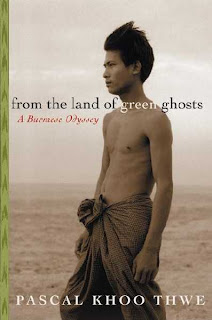
What can James Joyce do for you? In the case of Pascal Khoo Thwe, Joyce was responsible for throwing him a lifeline in dire circumstances in the middle of nowhere to a positive future. Yes, Pascal’s love for Joyce as a student cum waiter drew him to John Casey a Cambridge Professor who was touring Mandalay. This chance encounter led him to be rescued by Casey from the jungles along the Thai-Burma border to Cambridge where he became the first Burmese student to complete an honors degree in English Literature!
“From the land of green ghosts” is Pascal’s fabulous memoir that opens a window into one of the most closed countries of today – Burma and offers a perspective from the group that has been at the forefront of fighting for change inside the country – the students.
As a young Padaung growing up in a small town in Shan State, Pascal’s world was his tribe replete with rituals, shamans, soccer games, rice wine. This part of the book helped me understand the multi-cultural nature of Burmese society (the book even had a brief history of Burma which helped set the context). Having tried his hand at entering the seminary Pascal gave it up to go to Mandalay at the age of 17 to study at the prestigious University. Mandalay which was 375 miles away from his home town was an entirely different world and little did he know that this journey would be the foundation for his own awakening.
The transformation from a student to a political activist was catalysed by his falling in love with Moe – a remarkable Burman woman and an underground freedom fighter who was tortured, raped and murdered by the regime. Inspired by Aung San Suu kyi, tribal, religious and cultural differences were set aside when standing united against the Junta. As a reluctant witness to the atrocities perpetrated by the regime, Pascal could no longer take it lying low and his sense of security is shattered even when he returns to his idyllic village.
This sets the stage for the next phase of his life when he becomes a student leader and is forced to take refuge in the jungles along the Thai-Burmese border as a result of the Junta’s crackdown on students. Joining the Karenni guerrillas in these jungles, Pascal has front row seat to the fight against the military in these jungles and witnesses first hand the countless students falling prey to mines, mortars and malaria.
At such a low point in his life, he smuggles out a note to Casey in desperation asking for any help. Casey responds with books, money and a passage to the British embassy in Bangkok and eventually a UK visa and an opportunity to study in Cambridge. Overwhelmed with gratitude to Casey and guilt towards the friends and the cause he was leaving behind, Pascal’s decision to move to Cambridge was one of the most agonizing ones he had to make. A refugee and an outsider in Cambridge, far from the comfort of his tribe and friends, the pressure on Pascal can only be imagined. This memoir is a testimony to his achievements and his contribution to the cause.
On a side note, it was interesting to note the admiration for the British despite the colonial legacy, not just by the author but also from many Burmese tribes. BBC Radio is often their only reliable window to the outside world and life under the British was simply much better for the average Burmese when compared to life under the regime
Subscribe to:
Posts (Atom)