Monday, April 25, 2016

Flag art


Nothing like the MIngei for a quick art fix on a lazy Sunday afternoon. Mingei is the name coined for “folk art” – wherein everyday objects used by ordinary folk is worthy of a place in a museum. A preservation for posterity of everyday life from the past. I have dragged my daughter along to her share of museums everywhere from The Getty, The Louvre, Musee De Orsay, LACMA, the Huntington, and the local museums here and if she has to pick her favorites, I think she will pick Mingei first and the Orsay as her second. 
Let a child mess with a pepper tree once so they won't do it again. Messing with the #4 company is like trying to defeat a crocodile


The clever Anasi rules here
Loved this one as it had a woman leading a company!


Trust this company to protect and care for the diverse chicks
The Mingei, because of its focus on folk art makes it very approachable to everyone and you don’t need to have a degree in art history or know your periods or the difference between Monet and Manet, to spend an afternoon gazing there. Also due to their focus on folk, they exhibit art from around the world. The "artists" are everyday people and mostly remain unknown, so there is no pressure on the viewer to acknowledge something as a masterpiece even if it doesn’t feel that way just because of the name at the bottom. 

The mighty antelope wins the stool
Only a brave man will stand under a big tree
This week we went to see the 36 Asafo flags from Ghana that were on display.  The “Asafo” were military organizations that wielded power over towns in Ghana. These organizations were often in violent conflict with each other and their flags depicted either proverbs or sayings that were intended to put fear into the heart of their enemies. These days this has morphed into friendly competitions and rivalries.  

Think twice before taking on the eagles
Flags by their nature are political symbols and are often used in ceremonial associations. So I’ve never viewed flags as art and never associated art with armed militia, but these flags made me change my mind. The flags were used as tools to communicate ideas and customs in what was primarily an oral culture. The influence of Colonialism is also seen by the Union Jack on some of these flags (those made before Ghana’s independence). These cotton flags showed appliqued designs mainly of birds and hence appealed to me a bit more than usual.


Trust the female spirit to protect you

The wise owl who brings you luck
And then as always Mingei invited us to create our own art inspired by what we saw. I usually stay away from “art making” as I am quite terrible at it. Elementary school ‘needle and thread’ efforts have left me with very little confidence about my abilities except perhaps sewing on a loose button. But this time my daughter cajoled me into getting my hands dirty. Obviously we both went for birds, and obviously one can easily tell what her bird was – an owl, and obviously one can barely guess what I made. 


She came up with the idea of communicating a message through the flags we made. Hers was a noble one. She wants more people to love owls, and so she added a clover to hers to indicate owls can bring luck. I was struggling with mine. She thought, given the comical nature of my bird (kilew – let’s see if you can guess from the word blend which two birds are combined here), maybe I should make it a fire-eating kilew, that creates dread in the hearts of those who catch a glimpse of it.

If you are not frightened by the Kilew, I am sure you are positively frightened by my stitches. This is the stuff nightmares are made of!
The fire eating curlew who looks like a kiwi (hence Kilew)


Thursday, February 18, 2016

Books of January

While Mr. George RR Martin continues to demand every free minute I can spare with his brilliant Songs of Ice and Fire saga I found myself wanting to slow down from the feverish pace of the Storm of Swords and Feast of Crows with a number of "speed bumps" (and I mean that as a compliment) - books that are slow, haunting and savored and set a million miles away from Westeros.

Louise Erdrich was first introduced to me by a friend from the blogosphere, and since then she has quickly risen to become one of my favorite writers. Meditative, dark and funny at the same time I feel all her novels have the tendency to stir something in one's soul. I was mesmerized by the Painted Drum and Plague of Doves, that I don't know why I took so long to read "The Roundhouse" which picks up the stories of some of the characters from Plague of Doves. A violent rape (as though there is any other kind) in a reservation opens the novel and the effect it has on the close knit family and the community forms the crux of the novel, which is told from the point of view of the 13 year old son (Joe) of the victim. The politics of jurisdiction, rights of the Native people and the role of law should have made this novel a very political one, but by centering the story around Joe and his attempt to seek vengeance when justice fails his family it becomes a personal coming of age story instead of political. Mooshum is one of my favorite characters of all time and now I have to add Joe's friend Cappy to that list. Something about the book reminded me of River Phoenix's movie "Stand by Me".

J.G.Farrell's empire trilogy has long been on my book wish list, and I finally got to read Troubles this month. Troubles won the Lost Booker prize back in 1970s and details the collapse of The Majestic hotel in Kilnalough Ireland in the 1920s as a proxy for the collapse of the British Empire. If the background of the story was not the actual Troubles you could mistake it for a Wodehousian novel poking fun at the elitist British upper class. The Spencers who own the hotel are strong unionists, and the Major who arrived in Ireland following his "fiancee" is a confused spectator. While the rest of Ireland is erupting and regular clashes between the SInn Feiners and Unionists form the backdrop, the people staying in the Majestic are caught in their personal microcosmic drama while at the same time being touched by the events on the fringe. As all order collapses in the outside world, The Majestic reflects that and starts collapsing itself. The ending is no fairytale, which is true about the ending of many empires around the world. Although a bit dragging in some sections, the book is worth one's time.

I came to the audiobook version of "Third Policeman" on seeing a Facebook recommendation by the amazing Neil Gaiman. The Third Policeman is a cult classic by Flann O'Brien but Neil Gaiman was correct to recommend the audiobook version - read by Jim Norton. One has to listen to it for the voices and accents that Jim Norton has brought to life. The story is a big "pancake conundrum", with a combination of murder, physics, philosophy and bicycles. Reading this would've been fun, but listening to it was simply top notch!

Last book for this month is one of President Obama's favorites - "Gilead" by Marilynne Robinson. If the Roundhouse was a speed bump this was stop and go traffic on the 405, but still very enjoyable. Set in the small town of Gilead in Iowa, the story is about John Ames a 70+ preacher who is dying due to a failing heart. As he approaches death he wants to leave behind letters to his 7 year old son so he can "speak" to him from the great beyond as his son enters adulthood. Through these letters we learn about his past, his pacifist father and his fiercely abolitionist grandfather who were all preachers. When the prodigal son of his best friend returns to Gilead, John Ames fears that his namesake would exert a negative influence over his son and his wife especially after his time. A story about religion, spirituality, liberal vs conservative values, politics of color and fathers and sons, I found the book quite captivating that I wouldn't mind being with it when stuck on the freeway.

That along with the two books from George RR Martin wrapped up my January. Daughter and I have also wrapped up "The Two Towers". I have paused in my reading of The Antropocene, but hope to get back to it soon. Edna O'Brien and Neal Stephenson are leading the charge for next month. More on that later.

Sunday, January 3, 2016

To catch the time thief

3 months seem to have been stolen from me by the infamous Time Thief as i finally (re)turned to my blog today. I decided that the best way to get this done is to actually begin, and so here I am. Family, work, Netflix (more or less in this order) took up my 3 months and now as I try to recall everything that I read I am having a hard time.

So before I start, here is a glimpse of my reading pile by my bedside - more a memory aid for me for the future.

As I mentioned in my September post I worked through three books in October - Slade House by David Mitchell, Heart Goes Last by Margaret Atwood and Sorcerer to the crown by Zen Cho. I preferred the books in the same order that I have listed them.

Slade House - what can I say? David Mitchell can't seem to do anything wrong according to me! My only complaint was that this book was too short and not scary enough. After having read Cloud Atlas, Thousand Autumns, Bone Clocks, I wanted more pages, more visitors to the mysterious Slade House, more portals, more scary stuff and more of Marinus.

Heart Goes Last is another dystopian world view by the prolific Margaret Atwood. After the collapse of the world economy, people live in cars eking out a living in whatever way they can. So when the Positron project promises clean sheets, comfortable beds and full time employment why would anyone pass up on this opportunity! The only catch is that your year is spent in two distinct periods like a modern day King Vikramaditya. You have full employment for 6 months, and then you spend 6 months in a prison within the community - not the type of prisons you see in Hollywood movies, more the type you might see in Scandinavia. As with all Atwood novels there is a lot of dark humor, and weird science (most of which is already real in some shape or form). A fast read, not as fantastic as the MadAddam trilogy, still enjoyable.

Sorcerer to the Crown was the most talked about book among fantasy fans and its release was highly anticipated.  England is facing a magical crisis as some kind of squabble with the fairies has led to a reduction in magic. Politically England is also dealing with France (non-magically) and the kingdom of Janda Baik (magically). It is also the time when women are not allowed to practice magic openly and are usually sent to a finishing school of sorts so they learn how to control their "unfortunate" magical abilities. Not a great time for the Sorcerer Royal to die and have his adopted black son Zacharias succeed him to the post. How does Zacharais deal with all these issues? He has a bit of a help from Prunella Gentleman - also dark skinned, and a rebel who wants to escape her finishing school and actually practice magic. Feminist fantasy novel, still it didn't manage to ensnare me. Maybe the hype was a bit too much and raised my expectations too high for Ms.Cho to jump over.

November and December I spent with Game of Thrones and Clash of Kings and am about 1/3rd done with Storm of Swords. I am officially now a fan, completely hooked by the plot and following the fates of all the different clans and dragons. Very medieval so needless to say there is a lot of death, murder, rape, war, and even incest, but there are enough strong women characters to keep me interested and the plot is just amazing! I don't think I will be able to watch the HBO series though as some things are best left to words than to pictures. I am now taking a break from the books and reading a couple of Wodehouses just for a change.

Also read Corsairs for OBOC- Qatar by Abdulaziz-Al-Mahmoud. Set in early 19th century in the Arabian peninsula, it is a great piece of historical fiction. Britain is trying to get control of the waters around the peninsula as it is an important trade route from India, so as usual they enter into many shifting alliances. Wahabbism is also gaining popularity in the region and Britain wants to use the pirate Erhama Bin Jaber to help them achieve their strategic aims while forming an alliance with Oman, Persia and Egypt. Erhama is his own man and refuses to join the English and only wants to pursue his personal vendetta. Erhama's son strikes an unlikely friendship with an English Major who is the custodian of a priceless sword to be used to seal the deal with Egypt. A very well written book and is a must-read for anyone trying to understand the geopolitics of the Arabian Peninsula. Although it is fiction, there are lessons here that could apply even today as politics makes strange bedfellows.

These are the only books I recall having read in the past 3 months. I have more to write about other things (especially the unprecedented floods in Chennai and my short visit back home), but that requires more thought. Today I just wanted to get started with blogging and free myself from the captivity of the time thief.
 

Wednesday, September 30, 2015

Hits and Misses

The last month has been one of hits and misses for me in terms of the books I picked up. Reminded me of a quote I read somewhere "There comes a time when you have to choose between turning the page and closing the book".

As the Booker longlist was announced I couldn't wait to read some of the books that made the list. By the time I sat down to write this post, the shortlist was announced and none of the books I had read (completely) made the list.

Started with Anne Enright's "The Green Road", a woman Irish writer, I can't believe I had not read her before! The Madigan family's trials and tribulations are traced over the course of many decades and we see Ireland's boom and bust cycles as we go through the decades. The novel is told in different voices (from the point of view of each child) over different time frames. So each chapter seems to be a short story with a loose connection to the previous ones. As the children grow up and some leave Ireland we travel along with them to the US and even Africa. The final action takes place once again in Ireland as the four Madigan children (Dan, Constance, Emmet and Hannah) are forced to come together as their mother decides to sell their childhood home. I should say I liked the sections set in Ireland the best and found the US and Africa sections a bit tedious - decided to turn the page instead of closing the book, but it left me wanting.

Then I picked up "The Moor's Account" by Laila Lalami. The book tells the story of the little known (at least to me) attempt by the Conquistador Panfilo de Navraez to capture Florida coast and claim it for the Spanish crown back in 1527. The journey starts out with 600 people and ends with 3 survivors, one of whom is the Moroccan slave Estebanico who is the narrator of this novel. The Moor is trying to provide a more honest version of what really happened as opposed to the sanitized version of the expedition supplied by the other two "gentlemen". Facing death, disease, and starvation the survivors managed to get from Florida to Mexico where they are eventually rescued thanks to the many Indian tribes they meet along the way - some hostile, but most willing to provide some food and shelter in exchange for labor or gifts. I enjoyed Estebanico's (formerly Mustafa) backstory, how he sold himself to slavery due to poverty, and then spent the rest of his time trying to get himself out of that state. It is also a story about stories and words - how powerful they are. Overall this was one where I kept turning the page, and I am sad it didn't make the short list.

"Satin Island" which has made the short list was one that definitely was not my cup of tea. I closed the book half way through, as it was more form over function, style over substance kind of book similar to "A visit from the goon squad" the 2011 pulitzer winner. If this one wins the Booker and someone explains to me why maybe i will revisit it, but that seems unlikely.

The non-fiction of the month was "Brilliant Green: The surprising history and science of plant intelligence". It is a short and easy read even for someone who might not be scientifically minded. Stefano Mancuso is a valiant defender of plants and wants to bring to light the step-daughterly treatment they have been receiving from humans who don't seem to understand that without plants their future would be pretty bleak! The book gives us a cliff notes type overview of the scientific discoveries in the last few decades pertaining to plant intelligence, sensing, social behavior. Very thought provoking, and yes while I still devour plants, I am more respectful of them these days. One of the side effects, is that my 10 year old has taken to practicing her recorder near our raised bed in the hope of encouraging the plants in our bed, similar to "Mozart for babies" (which I never did!)


The last two books for this post gave me an insight into pre-teen/teen boys almost like the movie "Boyhood" did! Roddy Doyle's Paddy Clarke Ha Ha Ha and David Mitchell's Black Swan Green are both Bildungsroman novels that trace one year in the life of Paddy Clarke (in Dublin)and Jason Taylor (in the fictional village of Black Swan) respectively. Roddy Doyle won the Booker back in the '80s for his book. It was not an easy read unlike Black Swan Green, but both were very educational for me.

Continuing this theme of Bildungsroman and teenage boys, I am the middle of reading "The Fishermen" by Chigozie Obioma. If I were the betting kind my money for the Booker would be on this one! I am only about 2/3rd of my way through, and this is a hard to put down book.

October looks exciting thanks to Slade House, Heart Goes Last and Sorcerer to the Crown - three books I've been looking forward to for quite some time. Also after much hesitation decided to pick up Game of Thrones (the books, not the show) - late to the party, but want to see what it is all about. My curiosity was piqued because of the comparison to Tolkien.

For now daughter is into The Hobbit which I am reading to her for bedtime, and we want to move onto Lord of the Rings even if that's going to take a couple of years to get through. How long she will want me to keep reading to her at night, I don't know but I intend to savor it as long as I can and if Tolkien can't help me, no one else can!


Thursday, August 13, 2015

4 out of 6 for women

July was a great month for women writers at our home! While J.K. Rowling held my daughter captive, I had a lot of peace and quiet to catch up on my own reading.
Calligraphy of characters from the series


Go Set a Watchman - everything that needs to be said about the book has been said already by countless critics and readers. As everyone debates about Atticus, my main takeaway was about Harper Lee's craft! Every time you hear great writers talk about countless previous drafts and how different the current novel was from the one they originally started with, you have no clue how truly different it turned out. To me this was the revelation from Go Set a watchman - how Harper Lee was able to finish a story, then go back and completely re-do it from scratch as though she had a clean slate. I was blown away by that. I sometimes struggle to re-order power point slides or even worse rearrange bullets within a slide, so this to me was a remarkable achievement, something that i think all budding writers should take note of. Now that both the books exist it is hard to discount one and focus only on the other, and harder still to not think of them as sequels.

The Time Traveler's Wife by Audrey Niffenegger was another book I finally got to this year. Was it science fiction or romance? I didn't care as I enjoyed the plot of a modern day Penelope waiting for her Odysseus who is chrono-impaired and has no control over when or where he time travels to.

The Jane Austen Book Club by Karen Joy Fowler was a disappointment to me. I came to this after "We are all completely besides ourselves" and the Jane Austen book just didn't do it for me. The premise of the book of course was interesting - 6 people, 6 novels and each person a representative of one of the legendary Austen characters, unclear who was narrating the story. Frankly most of their lives seemed boring and predictable like every person's life. While Austen is legendary for taking the mundane and making it exciting, Karen Joy Fowler was not able to pull it off (i.e IMO)

The next book was "At the water's edge" by Sara Gruen. I had enjoyed her first book "Water for elephants" and so when I walked into the library and found the book in the 2 week lease section, and read the blurb I couldn't resist it. One of my main regrets when I visited Scotland was not to have been to Inverness and the Highlands (something i hope to rectify in the future).So I am a sucker for a story which is set there and has the Lochness monster as a character. Once again this book was a good summer read, but not close to the previous book.

End of July the Booker longlist was announced. As I read through the blurbs I was fascinated by a few of them. I picked up "Illuminations" by Andrew O'Hagan. The Booker blurb described it as a book about "war, homecoming and families". I should say the war bit was tedious maybe because there have been other books that have done a much better job. So I almost skipped the parts about the war (Luke) and waited to read the bits about the families (Anne), dealing with old age, dementia, memories and confronting long buried family secrets - this part was very well written. Don't know if it will make the shortlist though.

The highlight of the month was a nonfiction book. "Sapiens: a brief history of humankind" by Yuval Noah Harari was one fascinating read! I have been recommending this book to everyone I meet.Of all the human species that once roamed the earth, what made the Sapiens unique and so successful? Our ability to cooperate in large numbers enabled by religion, money, empires, gossips, cognitive dissonance - in short our ability to believe and imagine a future not just as an individual but as a group. These charactersitics are not always for the better as they also led to imagined hierarchies (slavery, racism), rapid extinction of other species and the not so positive impact we've had on the planet. Human history has been often spin doctored to portray our species in a positive light but in Sapiens we see that History is just a collection of accidents. The book lays out our history in 3 sections - Cognitive revolution, Agricultural Revolution and the ongoing Scientific revolution. It is very hard to summarize our entire history in 400 pages, but the book pulls it off. It is certainly the best non-fiction book I've read this year.

Have more books from the Booker long list to get through in August. I am especially curious about "The Chimes" but finding it hard to get my hands on it. I am sure if it makes the shortlist it would be more widely available. Also want to read "Brilliant Green"  - a nonfiction book about plants, but if it proves that plants are indeed sentient beings I don't know what i will eat anymore :)


Wednesday, July 8, 2015

The wait is over....almost

5 more days to go before "Go Set a watchman" will be at my door. I don't recall awaiting a book release with this much eagerness. I know many people have been waiting for half a century for this and I have only waited for about three decades.

Harper Lee's "To Kill a Mockingbird" was introduced to me like so many other things by my dad. I was in 8th grade and was spending most of my time engrossed in murder and legal mysteries of the Perry Mason kind that my dad thought it was time to rescue me and improve my taste. So he handed me his copy of the Mocking Bird without giving me any clues as to what the story was about. Little did I know that something that begins so innocuously with a 13 year old boy breaking his arm, will have the power to break my heart.  I remember finishing it over one weekend and being moved beyond words. How can a story that is so distinctly American touch the heart of someone growing up in India, even before the onset of satellite TV and globalized culture! Maybe Scout was right when she said that there are just one type of folks, "Folks", and folks everywhere have related to the book over the last 50 years.

I have re-read the book many times. I go back to it almost every other year and have gifted the book to numerous friends and family members. In Scout and Atticus I have secretly seen myself and my dad, and now that he is no more I go to this book for most of my parenting and life advice.

So as you can imagine, as soon as the news first broke in February that a previously unpublished Harper Lee's novel was going to be released on July 14th, 2015, I was one-clicking my way to pre-ordering it. All the books I have been reading since that announcement seem like "opening acts" for the headliner, and I don't mean that derogatorily. Some of the opening acts are stars in their own right.

It has been a month of David Mitchell for me and J.K.Rowling for my daughter. While she wrapped up 5 of the Harry Potters in one month, I managed to finish "Cloud Atlas" and "Thousand Autumns of Jacob De Zoet" by Mitchell. While everyone raves about Cloud Atlas, I felt Thousand Autumns was a much better book. I enjoyed the pace, the setting (Japan), the period (beginning of the 19th century) and the voices. I am looking forward to Mitchell's Slade House to be released this October.

I had never heard of Karen Joy Fowler until the book "We are all completely beside ourselves" made the short list for the Booker. I finally picked up this book and I am glad I did not read a single review of it on the web as I believe most reviews contain spoilers. This was a book that I wrapped up in one day. When my alarm rang at 5AM for me to wake up and hit the gym, I simply turned on the light and picked up the book and read for 3 hours straight! I don't want to say more so I don't give away anything. But this is a book worth reading!

As part of my trip to Tanzania I read "Out of Africa", having previously only seen the Meryl Streep movie. This of course is the famous memoir of Karen Blixen who spent 17 years in Kenya trying to manage a coffee farm. Her fiercely independent spirit comes through in her writing and while some of the writing is written from a position of power, she also offers some deep insights into African culture, the people and their customs, and also about the colonists.

So i read two women writers in June, and two male writers. The second male writer was Colm Toibin who has become another of my favorite writers. I have previously raved about how well he writes women in his books. Nora Webster is another jewel in his crown. This also belongs to the category of hard-to-put down books for me. At 46, the heroine Nora loses her husband, is teetering on poverty, and is trying to do it right by her 4 kids and by herself. How she deals with her loss in a small Irish town where everyone knows everyone else and gossip and grief go together while "The Troubles" are also brewing in the macro world is just so beautifully written! The book is a triumph not just because of how Nora's character is portrayed, but also because of the care with which every single supporting character has been etched by Toibin! Once again he is hands down the best male writer to write women.

Now i am trying to read "The Secret History" by Donna Tartt, but unfortunately the mind is wandering to "Go Set a watchman" and I feel that maybe I should read "To Kill a Mockingbird" instead so I can prepare myself for the almost 30 year old Scout and the much older Atticus. My only regret is that my dad is not alive for this event. As I turn the pages on the adult Scout and the elderly Atticus, I know i will miss my own father, who would've read the book along with me and discussed it at length. Will Scout still have the same closeness with Atticus? Will Atticus remain the ideal man that he was 20 years back? Will Go Set a Watchman live up to the expectations?

Few more days to find out....

Tuesday, June 23, 2015

Jambo Jambo to the land of Hakuna Matata - Part 2

Day 0: Arrival into Arusha
Carved from a single piece of wood over 30 years
Landed in JRO airport around 8:30PM after a 20 hour flight journey. Bags arrived safe and sound. Greeted by Thomson folks and loaded into the Rovers. After a 45 min ride we reached RiverTree Country Inn where we were to spend the night. We could hear a stream in the background and smell an earthy green smell. Treated to a refreshing juice on arrival and after an initial round of introduction to the team and briefing we were quickly shown to our rooms.

Day 1: Arusha to Tarangire
After breakfast we met our head guide and the entire team that was going to be traveling with us for the next 8 days. We were going to Tarangire National Park famous for its herd of elephants. We stopped at the Cultural Center in Arusha, and were treated to some amazing African art.

At the entrance of the park we had a quick boxed lunch which was delicious. I was trying hard not to let my imagination get ahead of me. But I needn't have worried as nothing prepared us for what we were about to see. Impalas, Giraffes and Elephants of course, in herds of dozens to hundreds! The highlight of the day was seeing one such herd come down to a watering hole and quenching their thirst. A month old baby was  protected by the group and watching the baby scratch his royal bottom had us all in splits.

The Lone Mourner who couldn't walk away
I also experienced a humbling moment when we encountered a grieving elephant who was finding it hard to say goodbye to his/her dead companion. As much as I tried hard to not attribute anthropomorphic characteristics to this mourner, it was clear that this pachyderm was in sorrow. It was a riveting sight and left us humbled.

After a day of excitement we went to our campsite and checked out our tents. Treated to some bajiya for snack, had a hot shower and a delicious dinner and retired for the night. We were each given an alarm bell to ring in case of an emergency. Luckily we never had to use it even once.

The night was filled with sounds of elephants trumpeting, hyenas howling and some of us even heard lions roaring

Day 2: Tarangire

The kids started the day with looking for tracks of nocturnal visitors to the camp. Hyenas had left their footprints in the sand. This day was dedicated to exploring Tarangire. While the focus was on elephants, the fledgling birder in me has to mention the birds. The three birds that defined the trip for
Lilac Breasted Roller
me were the Lilac breasted roller, the Superb Starling (completely worthy of its name) and the White Headed Buffalo weaver! Having seen them only in aviaries in zoos before I was thrilled to see them in plenty in the wild.

The highlights for the day were our encounter with the first lion, seeing thousands of elephants near the swampy marshes in Tarangire and dealing with the anger of one of the matriarchs who was clearly not happy with visitors as she was fiercely protecting a newborn in her clan. We respected her wishes and left her clan in peace so much so we only have a mental picture of the incident. The mother in me understood where the matriarch was coming from.

In all the focus on the mammals I should not miss the trees of Tarangire. The Baobab or the upside down tree left its mark on the landscape. It was interesting to note that the Baobab's seeds need to be cooked to a certain temperature for it to germinate. This is achieved inside the gut of the elephants
The Baobab or Upside down tree
that feast on them. The Baobabs also have numerous scratches on them as the elephants seek them out to quench their thirst during the dry season. With a girth that would make Henry the VIII envious, the Baobabs give the Redwoods stiff competition for being the oldest living things on the planet. I would've loved to taste the leaves of the Baobab as they are supposed to be a delicacy and as nutritious as spinach.The other distinct trees were the sausage trees and the candelabras.

Day 2 ended with lessons in Swahili, some soccer and delicious dinner as always.

Day 3: Tarangire to Ngorongoro

Today we were heading out to the Ngorongoro Highlands to the Conservation Area.  The Masai are allowed to live within the area although the crater floor is dedicated to the wildlife. This was the big distinction between a Conservation Area and a National Park. The Crater has one of the highest concentration of wildlife.

Friendly soccer game at Aya Labe School
We first stopped at a local school called the Aya Labe School and interacted with the Head Master and some of the students. It was heartening to see so many girls at the school. The school had its own farm and a huge soccer field. The girls took to soccer with as much enthusiasm as the boys. After a friendly game of soccer we headed out to the famous Gibbs farm.

Hands down one of the most beautiful farms we've been to. It is a sprawling coffee estate, and the farm serves locally grown food in an ambience that is tasteful and luxurious. A resident artist was creating his masterpiece as we watched him work. The area was full of weavers (of the bird kind).

Then we continued onward to the Conservation area and reached our Nyumba. I have to mention our two local Masai warriors who were to guard us in the night with their spears.  Like Argus with a Hundred Eyes, they seemed to have eyes all over their body. If we ever strode away from the camp site, they were right behind us offering us protection! Not sure if it is a myth, but we heard that even lions back down when they see a Masai warrior and I can see why. I certainly felt safe knowing we had a warrior outside our tents, but thankfully the warriors never had to use their spears.

Day 4: Ngorongoro

This day was dedicated to wildlife viewing in the Ngorongoro Crater. The Crater is famous for the
A view of the crater from above


Big 5 - Lion, Leopard, Rhino, Elephant and Cape Buffalo. The Big 5 is a term coined by game hunters as the 5 most difficult to hunt. Other than the leopard we saw the Big 4 at the crater.

The origin of the name Ngorongoro was very interesting. It refers to the sound of the bells worn by the Masai warriors who went into battle in the 1800s. The sound struck terror into the hearts of their enemies and hid the fact that the Masai warriors were actually very few in number.
A solitary black rhino

A Flamboyance of Flamingoes
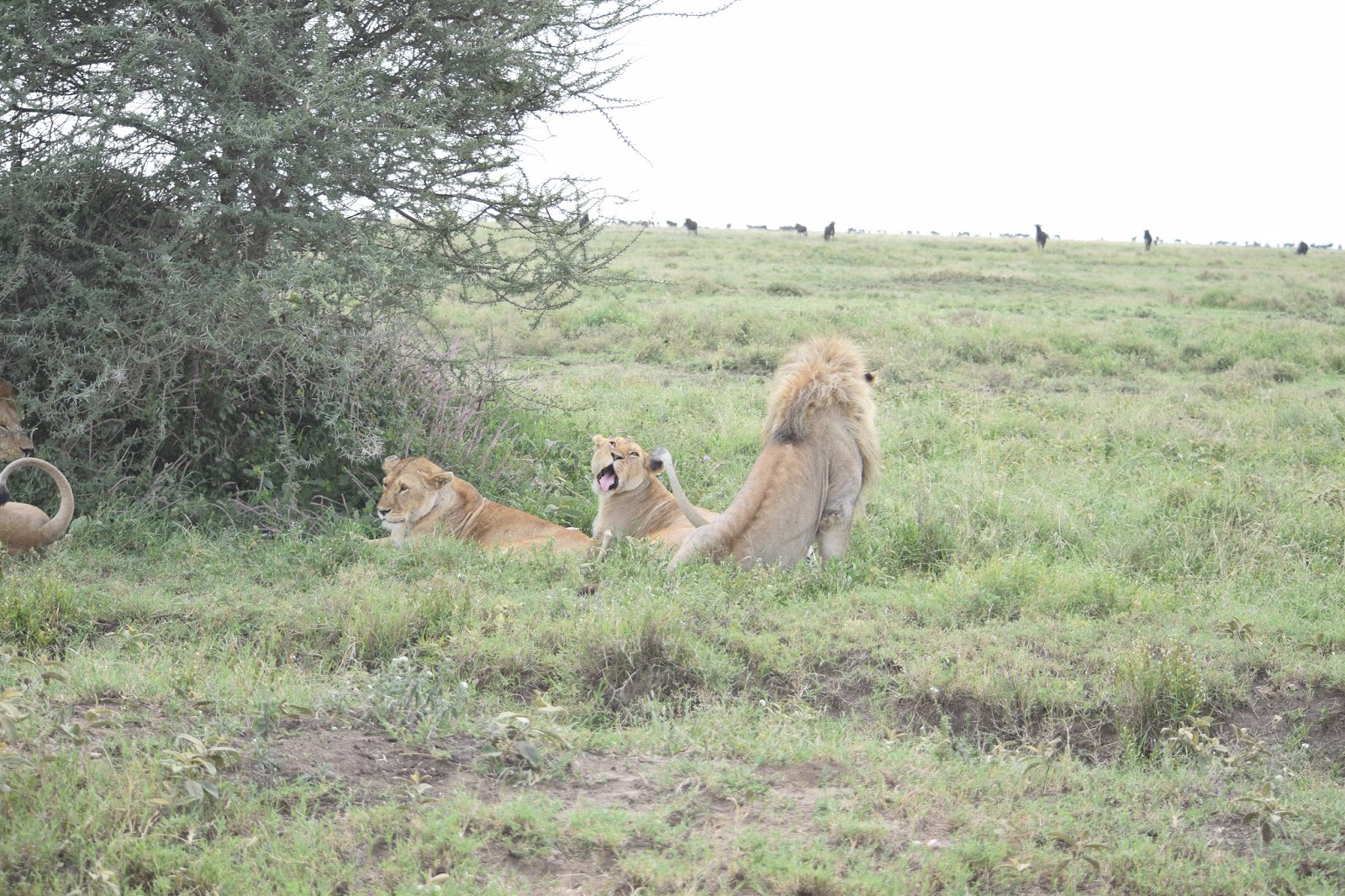
Once again nothing prepared us for the sights we were to see. Herds of wildebeest sweeping majestically through the plains (to quote Basil Fawlty) and buffaloes were only the start. Zebras locked in embrace as a camouflage were everywhere. We saw a pride of 5 lions, and one pair chose to mate right in front of our van. Happy to report that the kids took it in casually. The Crater was also home to the endangered black rhinos. We were lucky enough to spot a couple of them. Although no one knows the actual number of Rhinos in the crater we heard a number as low as 26. Poaching has been a huge problem until severe crackdown of poachers began a few years back.

There were no Impalas in the crater, but the place was teeming with Thomson's gazelle. The other highlight for us was the flamingo population at the saline lakes inside the crater. We saw a sea of pink from a distance. If you ever wondered why a group of flamingoes is called a "flamboyance", you can stop wondering. What a fitting term! The animals here are permanent residents as there is water available even during the dry season.

Often referred to as the cradle of life, or the Noah's ark of wildlife the crater defies definition and has to be experienced by every wildlife lover.

We had a picnic lunch at a hippo pool, and as we were heading back saw a few Masai herding cattle in the area. Our guide stopped to hand one of the young warriors a water bottle which was gratefully accepted.

Day 4 ended with delicious Tanzanian dinner and the kids learning to play Bao (very similar to "pallangkuzhi")

Days 5 : Ngorongoro to Serengeti

Today was the D day. We were heading to Serengeti, the majestic endless plains that at 6000 square miles is still only the second largest park in Tanzania but is the most famous. Its landscape comprising of savannah, kopjes, acacia trees, and hills. As we bid goodbye to the crater, we went through the Malanja depression and encountered many Masai along the way including boys with some kind of a face paint on them (probably getting ready for their circumcision ceremonies).

The Oldupai Gorge - home of early Hominids

Enroute we stopped at the famous Oldupai gorge. Oldupai (not Olduvai as misspelt by the German colonizers) has the oldest known evidence for hominid evolution and is the site made famous by the First Family of paleontology the Leakeys Louis Leakey was also the mentor for Jane Goodall and i especially remembered his famous saying "We redefine tool, or redefine man, or accept chimps as humans" following the chimp tool use discovery by Jane Goodall. We took a tour through the small museum and attended a very informative lecture on the geology and historical significance of Oldupai. An amazing place to visit, and it was quite moving to be there. It put us humans and our relatively short history in perspective.

As soon as we entered Serengeti we were stunned by the thousands of wildebeest as migration was in progress. Serengeti lived up to its name right away, as within 5 minutes into the park we encountered a pride of 6 lions just by the roadside. In all the excitement on seeing the lions we lost sight of the wildebeest and that proved costly, as that was to have been the only opportunity of witnessing the migration for us.

Close Encounter of the Spotted Kind
We had a boxed lunch and did a small hike to a nearby view point from where we saw little dark blobs of wildebeest dotting the plains everywhere around us. As we made our way into the park we were lucky to have a leopard walk right before our eyes. That  would be the highlight of the day, and was the closest we would ever get to a leopard in
the wild. Serval was another beautiful cat that we had a chance to observe in close quarters.

It was a long dusty, hot day but very rewarding in terms of game viewing. So we retired to our Nyumbas early and got a glimpse of the sun setting over the Serengeti plains.

Day 6: Serengeti

The acacia tree houses a couple of lions
This day will be best remembered for chasing after cats. We went from Kopje to Kopje and saw a pride of lions at almost each one of them. Serengeti is also the one place where we can see lions climb trees and sure enough we saw a bunch of those too. At last count we had seen close to 45 lions in a half day of game viewing.

Cheetahs were very elusive and we managed to catch a glimpse of a couple of them hidden in the grass. Cheetahs are day time hunters unlike the other big cats. Still the two we saw were just happy to laze around in the grass.

The two curious animals for me were the Agama Lizard (shocking red and blue), and the Hyraxes which looked like rodents but were apparently related to elephants!

The evening was spent beading and story telling. Our mentor talked about the value of story telling in an oral culture like the Masai. Every story had a moral and passed on important messages and values from one generation to the other. With rain pelting the plains, the kids were happy to curl around the mentor and hear and share stories.

Day 7: Serengeti

The day belonged to the hippos. We went from one hippo pool to another and saw hundreds of them lazing around. It is a wonder that some of the largest animals in the world are herbivores! Hippos kill more people in Africa than any other large mammal and so deserve our respect despite their lazy demeanor.
Death of a Hippo, Feast of a Crocodile

The kids were mostly seeing life everywhere around them, and today they also encountered death as we saw a massive floating dead hippo in the pool. A Nile Crocodile was stealthily feasting on the hippo.

The rest of the afternoon was hijacked by birds - from big ones like the ostrich to small ones like the larks, we saw so many species that at last count we were at 52 species! Didn't expect a bird bonanza at Serengeti.

Day 8 - Final Day

Clearing the "runway" with a rover
Although it was the final day, the adventure was not yet over. We were to depart to Arusha in a small 13 seater plane. The runway was flattened grass which was shared in true African style with Zebras and Giraffes. The Rover had to go around chasing them from the runway so our plane could land and take off! From high above we spotted our camps and for the first time it hit me how truly I was in complete wilderness in the middle of nowhere!

Our camp from up above
A week went by so quickly, but it was a week when every moment was truly savored. Disconnecting ourselves from the digital world, helped us all connect very closely to
each other and the physical world around us. With immense gratitude to the guides, drivers, camp staff, chefs we said our last good byes. This was truly an experience like no other. In a time when you hear about species extinction at alarming rates everyday, seeing so many animal babies in these protected areas made me feel more optimistic. All of us felt that this is an experience that will stay with us forever.

Will I ever visit Africa again? I honestly don't know, but I sure hope that my daughter would and she would be able to bring her kids some day to soak in the wildlife as she did. Will the Rhino be around? What about the Leopards and Cheetah? Will they become relics of the past or will they live to tell a tale, not just in the form of "Lion King"?