Monday, March 30, 2020

Closeted Contemplations

It is said Shakespeare wrote "King Lear" when quarantined during the plague. Thoreau wrote "Walden" when he self-quarantined himself to simply experience solitude. It's been two weeks since "Shelter in place" began in California for the Coronavirus and yet it has been so hard for me to put pen to paper so to speak. My neighborhood is eerily quiet and the freeway noise has died down. Birdsong is loud and clear. Inside the house we've each colonized a space as our "work area" and during school/office hours we sport our headsets and are glued to our screens. The saving grace is we have all our meals together, play at least a boardgame together and go for a walk in the dark, you guessed it, together.

I know I am privileged as I am able to work remotely and am getting a paycheck and most people I know are healthy. The economy is tanking but I have a shock absorber that will hopefully take me and my family through, something that countless others cannot count on. However, privileged as I am, I cannot help being caught up in fleeting moments of nostalgia and feeling sorry for ourselves - when can we go on a proper hike, when can I go to The Getty, will I ever be able to travel? But these moments pass and I try to take a look at the positive. What Greta Thurnberg struggled to achieve, the coronavirus has temporarily achieved - cleaner air and a respite for Earth from human pollution. Spring is here and there are birds nesting in my backyard. Signs of bird-life everywhere even if everything else is looking dead. Despite being closeted together 24 X 7 we've managed to not get on each other's nerves too much. Since I am not driving it has given me back some valuable time which I have spent reading and visiting art museums online.

I wrapped up Mantel's masterpiece "The Mirror and the Light" last week. I wouldn't be surprised if this one also wins her the Booker for the third time! There are so many things to say about the book but the plague and sweating sickness which feature only in a minor role in this book seemed prescient. Her characters deal with the plague as a fact of life and are ruled by a selfish, fickle king. The trilogy is a perfect companion for these times.

This week I spent a lot of time visiting the Van Gogh Museum online. I was lucky enough to have been there in person two years back. I remembered the "Skeleton smoking a cigar"
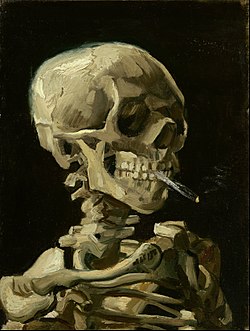
A skeleton, turned 45 degrees to the right and rendered only from shoulders and above. The skull clenches a lit cigarette between its teeth. The painting is rendered in somber tones of ivory, brown, and black, in thick yet detailed brushstrokes that reveal the texture of the canvas in places.

I don't know how well known this painting was, but it was new to me at that time. And then I found out that Tamino's song "Cigar" was inspired by this painting. Tamino's concert was the first casualty for me due to the Coronavirus. I had tickets to go see him on March 11th in LA and we decided to cancel in the interest of social distancing.

More than the sunflowers and the irises I remember being struck by Van Gogh's paintings of trees - where he focused not on the top but on the bottom - the roots of trees. I am reading "Underland" by Robert McFarlane and hence I seem more tuned to looking at the understorey


Vincent van Gogh - Tree Roots and Trunks (F816).jpg

 This was one of my favorite Van Gogh paintings. One of my friends went on a forest walk in India a few weeks back and wrote a poignant piece on what the forest meant to him. He talks about the need to slow down to nature's pace to become resilient. Maybe it is just that my brain is looking to make sense of these quarantines and social distancing, but his words seemed to resonate as we've all slowed down these past few weeks and there is no doubt that we have given the Earth a chance to heal. But will we able to heal and recover from this? Only time will tell.

Let me close this random rambling post with a self portrait of the man


The bandaged ear recalls what happened after 60+ days of spending time with Gauguin (only partly kidding). As we are all closeted with our near and dear ones - a friendly reminder to take care of boundaries, not to push each other's buttons and to pay attention to our mental health in unprecedented times like these.

Friday, March 13, 2020

On Privilege

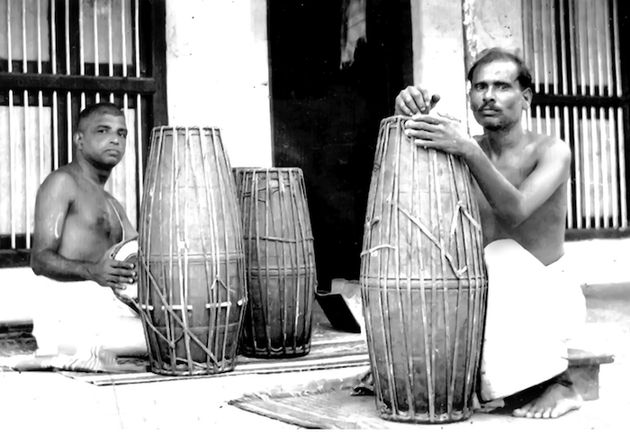
T.M. Krishna is a musician I deeply admire not just for his musical abilities but also for his willingness to take on uncomfortable questions in the Indian Classical Music (specifically the Carnatic) world. Depending on which camp one falls in, he is viewed either as a progressive musician or an elitist trouble maker. His latest book "Sebastian and Sons" is a must-read whether or not one is into Carnatic music. This is a story about the first family of Mridangam (the foremost percussion instrument in Carnatic) makers who belonged to the Dalit (formerly "untouchable") communities and were often behind the foremost artists majority of them being upper caste Brahmins. In a quest to shine the light on these makers, T.M.Krishna walks us through the process of making Mridangams and helps us appreciate the art, the craft, the science and the sheer physical labor that goes into making these percussion instruments which are so revered and worshiped by the upper caste.

You can ask anyone from India for characteristics that define a Brahmin and I bet vegetarian, cow-lover, classical music connoisseur will show up in a list that may include religious and intellectual. So it is ironic that the Mridangam is a skin instrument that relies on healthy cows (especially female that have given birth to one or two calves) being slaughtered specifically for their skin, a fact that I was ignorant of or perhaps blind to. T.M.Krishna shines as a historian of music and the legwork he has done for this book has taken him to slaughterhouses and into the homes and workplaces of the legendary makers. At the heart of the book is the relationship between Mani Iyer and Parlandu, the artist and the maker, who together changed Mridangam and Carnatic music. However, Parlandu's story is rarely talked about or even known and this book attempts to change that. Although both Mani Iyer and Parlandu are no more, their stories are told through their progeny and students. In giving the "other" a voice, TMK is careful enough to make sure he is only a medium and the only judgements he passes are about the music.

Two men dominate the narrative in 'Sebastian and Sons'—Parlandu, a brilliant innovator and mrdangam maker,...
A picture from the book - Mani Iyer and Parlandu


This is also a book about privilege. There is a quote that is attributed to Chomsky that says "The more privilege you have, the more opportunity you have. The more opportunity you have the more responsibility you have." TMK is not adopting a holier-than-thou attitude in this book. As a man of privilege he is taking that opportunity to understand the sources of his privilege and feels that the whole Carnatic music world has a responsibility towards these makers who need to be not just acknowledged but also celebrated. Cow protection shows up in the Indian constitution and there are many who think that beef eating should be banned in India. However, the classical arts which rely on slaughtering animals especially the cow exposes the hypocrisy of this cow-loving stance.

Personally, this book affected me a lot.  As a Brahmin I grew up surrounded by Carnatic music. I was also surrounded by numerous "others" who did not belong to my social class. My parents and even my grandparents were generally very tolerant, but there were so many coded behaviors which were passed along from a place of privilege. There were numerous people in our lives who did not belong to our social strata and on whom we depended on - my mom's rickshaw driver, our maid, the lady who sold flowers, the lady who ironed our clothes, the newspaper recycler, the bicycle repair man, and the watchmen of our colony. My parents showed kindness to them, loaning them money, offering them a cup of coffee or food. My mom would always get down from her rickshaw when in an up slope and would walk next to the puller so as to not burden him unduly. My dad even attended the weddings of a couple of them and was the first to show up to the police station when one of them was wrongly accused of theft by someone else in our community. However the benevolence was often marked with certain class conditioning that both sides followed. They never sat on our couch, never entered our kitchen, always had a separate set of utensils from which they ate or drank and always addressed my parents with respect. I wish i can say I knew each of their names. Unfortunately a few were simply referred to by their professions while they addressed my parents as Sami or Iyer amma. Ironically the lady who ironed our clothes was christened by my brother as a toddler as "Sami" as he thought she was announcing herself when she was really addressing my dad - so in an interesting double twist she became "Sami" (upper class male) at least at our home until the end of her life. When TMK tries to understand who Parlandu truly was he is unable to break down the wall and beyond his technical skills was never able to get to the stories about the man behind the Mridangam. Similarly, I often look back on these people who formed part of my daily life and realize that I never really knew them as the caste barriers cropped up.

This book is an eye-opener on many levels, but especially on a personal level if you grew up in a privileged position. Privilege does not automatically mean a position of financial or political power. On the contrary many Brahmins (including my own family) were not wealthy. There were no ancestral properties. My parents didn't even own a cycle, or great luxuries, relied on public transportation for their entire working career and worked hard to pay off their mortgage. They had little to no influence in the corridors of power. Their votes hardly counted. However, we all grew up with a feeling that our lives and stories and that of our ancestors mattered and that was a feeling that gave us confidence in our future. Decades of Dravidian movement that had an anti-Brahmin policy at its core or an affirmative action policy that tried to shut off Brahmins from public sector jobs or educational institutions had still not significantly dented the cultural cache of the community or the upward movement of the class. The privilege also meant that someone else did our dirty jobs for us - whether that was repairing the sewer of the city or slaughtering a cow for its skin for our precious instrument.  Although unchained from the shackles of caste in the US, I realize that I need to be continuously aware of my privilege. TMK's book is a clarion call for awareness more than anything else.

Friday, February 14, 2020

In Praise of Leisure

President Garfield is my new hero! If you are wondering if the bar has become so low (which it has), hear me out. I've previously expressed my fervent enthusiasm for Lincoln, Grant, FDR - you know - the usual suspects who make most people's Top 10 presidents. Yes, abolishing slavery, winning the Civil War and seeing through reconstruction, and the New Deal are all the things that made us who we are. But Garfield had one quality that the others lacked. He LOVED leisure and preferred reading to anything else in the world. Lincoln read a lot too but never once did he say I would rather read than be President! I recently re-visited Sarah Vowell's Assasination Vacation and she reminds us that Garfield was kinda like "The Dude" from Big Lebowski. Has anyone ever delivered a commencement speech like the one Garfield gave? According to Vowell, this is what Garfield told young graduates:

It has occurred to me that the thing you have, that all men have enough of, is perhaps the thing you care for the least, and that is your leisure - the leisure you have to think; the leisure you have to be let alone; the leisure you have to throw the plummet into your mind, and sound the depth and dive for things below.

I appreciate his sentiments now more than ever in my life, and not just for me but for my teen too! One of the things my high school-er laments about, is not having enough downtime for herself to do things which are purely for her own pleasure and not because some college wants to see it on her resume. She creates these elaborate maps of fantasy lands that will make Tolkien proud or draws dragons that the Khaleesi would love to ride on or write powerful poems. This is just a way for her to process her rich inner, imaginary life that she always had time for until she entered high school. Diane Tavenner in Prepared  emphasizes the need for this leisure (that is disconnected from prepping for college) as an integral part of preparing for life and unfortunately the high-school to college route does not allow for such detours. Don't get me wrong, my child enjoys school in general and does sign up to do a lot of things, not for resume-building but purely because she wants to try a bunch of things. It is a herculean task to organize her schedule, especially if she also wants to get eight hours of sleep every night. Which is why Garfield's advice is so timely and profound. 

This is also true for adults. I work in two time zones these days and am busy at home even with a spouse who shares housework and chauffeuring duties. I have also reduced my Netflix time and am not on social media and I do read a lot. Yet, there is a yearning in me that resonates with Garfield's love of reading. It also recalled to my mind one of the last pieces of advice my dad gave me when I was in between jobs and before starting a family - enjoy your downtime. Instead I remember being anxious to find work and get going with my career. 

So what can I do - both for myself and as a parent? How do I bring more leisure into our lives without compromising on our professional and personal commitments? All solutions offered today involve multi-tasking (audiobook when driving, conference calls during dinner prep, walking meetings) and leave me feeling busier than ever. 

Well for starters I am going to stop trying for perfection in everything. If the house is a little messy one evening, that's OK. I am also trying to do a 5 line journal every night - just a summary of the day. Nothing profound or thought-provoking but before I hit the bed I take stock of the day. I am now doing 10 minute solitary walks, usually I am processing something and not being mindful, but for a few seconds I stop and stare at a bird and try to focus on the here and now. I am also reading books that make me read slow - yes I do read a lot of page turners and thrillers, or history that gets me riled up, but am trying to mix it up with a bit of Thoreau to Robert McFarlane who slow me down. Just some baby steps to incorporate a slower tempo into an otherwise rushed day. Let's see how these experiments work out.

Thursday, January 2, 2020

Books of 2019 and looking forward to 2020

2019 was the year I finally wrapped up my online M.A. in English with SNHU. When doing the M.A. I realized I didn't have much time to read anything else besides the assigned reading. But as luck had it, my Capstone professor allowed us to pick our own books for our final thesis and I had the pleasure of analyzing Ann Leckie's Imperial Radch trilogy as it also helped me get my head around questions about Artificial Intelligence, Robots and the emerging forms of slavery. I don't know when I started reading Leckie but this year was all about her for me and I have been recommending her space operas to everyone. I also re-read Dune as my daughter was "forced" to read it for school. Dune as she knows is one of my favorite books period.

Otherwise 2019 has been mostly about non-fiction for me. I read the long awaited William Dalrymple's book Anarchy about the East India Company. It felt like reading a novel and gave me new insights about 300 year old multinational corporations and mercenary armies. Incidentally, this book made President Obama's list for 2019. My favorite read for this year though was Chernow's biography of Ulysses. S. Grant simply called Grant. What a work and what a man! I had no clue about the reconstruction period in America and this book told me how much Grant did to maintain Lincoln's legacy. He is a flawed man, definitely naive but his achievements and his moral compass on many issues are to be admired. This book was also recommended by my other favorite writer Ta Nehsi Coates for educating oneself about the Civil War, Slavery, and Black America. As I wrapped up my English I re-watched Shakespeare's plays on the War of the Roses (The Hollow Crown series by the BBC) and this led me to read Dan Jones' War of the Roses. Once again a historical work that reads like a gripping novel.

On the science side, I read The Evolution of Beauty by Richard O Prum which talks about Darwin's theory of sexual selection and how beauty can be selected simply for the sake of beauty. I have been taught to believe that everything in nature was selected for its utility so this was a very different perspective for me. Also made me think about art for the sake of art and why it is essential. Finally got to Cynthia Moss' Portraits of the Wild where she talks about her African experience. Though not as engaging a writer as say Jane Goodall, it is still a great read. On the philosophical front I read At the Existentialist Cafe by Sarah Bakewell whose previous book on Montaigne I really enjoyed. She is a terrific writer who has the skill to translate complicated ideas (especially Heidegger's) into simple terms.

Finally I read two amazing books to wrap up 2019. Invisible Women: Data Bias in a World Designed for Men by Caroline Perez which won the Royal Science Society prize and Gina Rippon's The Gendered Brain. While the former argues that treating the default as male and ignoring the data about the "other" 50% of the population affects every aspect of our lives (Government, Health, Transportation, Technology, Medicine, Safety) the latter argues that there is no fundamental difference between the male and the female brain. The differences we see come from cultural conditioning from as early as the first days of life. Everyone should read these two books maybe in parallel as together they offer a complete picture of gender and "othering". Those were some of my highlights of 2019 and now what am I looking forward to in 2020.

2020 Books:

On the fiction front, Hilary Mantel's Mirror and Light is the most anticipated novel which will wrap up the Wolf Hall trilogy. I know Cromwell is going to die and I didn't know that I could be affected by it but here I am. The next book for me will be David Mitchell's Utopia Avenue. I've read almost everything he has written so I know I will pick this up right away. I don't know if Birnam Wood by Eleanor Catton will be published in 2020. If it is I will be pre-ordering it and staying up to finish it, just like I did her last book The Luminaries.

On the non-fiction side, I plan to read We the Corporations by Adam Winkler as I liked his interview on Democracy Now. Bill Gates recommended Prepared for all parents of high schoolers. So will give that a go. As someone who is afraid of the water I am intrigued by The Boundless Sea. It is a 1000 page heavyweight, but I might try it. I also plan to read Wendy Donniger's The Hindus: An Alternative History to see what the hooplah is all about. I also have on my queue The World Undone a single volume history of World War I. Another book I've wanted to read is Laura Dassow Walls' biography of Thoreau. I plan to visit Walden before 2020 ends and it is always great to read Thoreau and read about him. If after all this I have the time I will pick up Casey Cep's work on Harper Lee's true crime work called Furious Hours.

This is my plan anyway. I am sure some will get dropped along the way and others will get picked up. But with my M.A. now done I hope to not fill up that time with Netflix or Amazon and actually get to all these and more!

Thursday, October 31, 2019

It's scary out there!

As we prepare for Halloween tonight I am reminded of my mom's first Halloween in the US about fifteen years back. She was visiting the US from India for the first time, had never heard of Halloween and was caught by complete shock to see people proudly displaying bones, graves, bloody hands, and ghosts in their homes. What kind of celebration was this! She could not understand why I would purposely place cobwebs and spiders on my front porch, especially following the Indian festival of lights or Diwali when one expects to light bright lamps to chase away these very ghouls and spirits of darkness.

I gave her every rational explanation I could come up with ranging from the mythological (the Celts, the blurring of boundaries between the living and the dead) to the psychological (good for kids to get scared a bit) to the biological (bats and spiders are actually important species that need to be celebrated). Her only answer was that the world is scary as it is, especially the world these kids were going to inherit, so why not let them enjoy their childhood when they can. I didn't think much of this until these past few years.

As kids come trick-or-treating into my neighborhood these days I don't think the true scares are the ghouls or the haunted houses but as my mom rightly indicated, it is the world they are inheriting. California with its raging fires looks worse than any artist's depiction of hell. My teen who was blissfully unaware of the complex, nuanced problems faced by the Kurds in Syria until last week, caught up with it on John Oliver and turned to me to say "That's scary"! For the record she did the Haunted Trail at night and said "it was OK". We are now living in a Baudrillardian simulation where we go the extra length to create unreal experiences while ignoring the reality around us. It's truly scary out there just not on October 31st!

I should also point out that on her first Halloween night my mom opened the door not knowing what to expect and was overjoyed to be greeted by princes and princesses, soldiers and pirates, firemen and cutest witches and a whole bunch of animals that all her objections went out the door! Seeing the cheerful kids and handing them candy was such a delight to her that she was happy to give up reality and fall into simulation mode. So yes, I wrote all this but didn't have the heart to deny trick-or-treaters or burst their bubbles. So I will pretend to scare them with cobwebs and gravemarkers knowing fully well they are not scared and are here for the candy. Perhaps this is truly one of the last stands of childhood pleasures before they grow up!

Thursday, July 18, 2019

Mama, Do you Love me?

I haven't posted anything here in a long time, but this week's events have forced me to sit down and process my thoughts. Some of you may have heard of this book "Mama, Do You Love Me?" by Barbara M. Joosse. If you look it up you will see that it is a book highly recommended for toddlers. A beautiful board book with illustrations depicting the Inuit culture telling the tale of an everlasting, unconditional love that a mother has for her child.


I believe this is a book that everyone should read and re-read throughout their lives. I certainly do. The mother in the book is at times frustrated, worried, anxious, saddened, and even angry as her daughter challenges her and pushes boundaries but throughout all she assures her little one that she truly loves her no matter what. As a mother of a teen, I can attest to the wisdom in this book. Naturally, teenagers test boundaries. Living with a teen means living with eye-rolls, tantrums, misunderstandings and conflict. But throughout all of this there is an underlying feeling of unconditional love that a parent provides to a child. Unconditional love does not mean no boundaries, no criticism, no feedback, or no conflict. On the contrary, as I remind my teen often, all the guidelines, suggestions, and even criticism comes from a place of caring deeply. And, yes there are times when I am wrong or over critical but the fine tuning and adjustment is part of the process.

What does a toddler's book have to do with the political events of this week? A lot! This week an immigrant politician has been asked to 'go home' as she is not able to see the 'flawless' nature of her adopted country. Her love for her country is questioned because she has been quick to criticize this beautiful nation. Does loving a country unconditionally means turning a blind eye to all its problems? Is it wrong to criticize the fact that universal healthcare is still a pipe dream, homelessness and the struggle for equal pay or living wage is still ongoing in a nation that boasts unprecedented wealth? What about lack of leadership in climate change or how we deal with migrant children at our borders? Is our Union so perfect that all these struggles are just "fake news" and conspiracies? Aren't the voices of the people in Flint, Michigan, the activists in Black Lives Matter, or the #Metoo movements speaking truth to power? What I truly love about my country is that dissent and discourse is not just tolerated but welcomed. Hyphenated identities were in the long run seen as enriching the culture of the US and not a blemish or a blight to be eradicated. "A more perfect Union" is what the Founding Fathers aspired to and shouldn't that be the goal of every citizen? How can we find solutions if we don't even want to acknowledge the problems.

Love does not mean being blind to faults. Love does not mean not being honest. Love certainly does not mean cover-ups or wishing away problems. The little girl in "Mama, Do You Love Me?" totally gets this. Otherwise we would've been reading about a spoiled brat with removed-from-reality, snow plowing parents who leave her totally unprepared for life's inevitable challenges!

Tuesday, February 28, 2017

Of Birds and Bees


These are uninspiring times if you go by the sociopolitical situation in this country. I am not saying this is a time for inaction,  just that we live in uninspiring times. So I’ve stayed away from writing except when required, but this weekend was very different. The Bird Festival was in town and it was a privilege to spend some time with winged creatures who soar to much greater heights than many of our so-called leaders. My daughter and I attended a workshop on birding by ear, which on the face of it appears pointless to a person who has hearing issues, but that didn’t stop me. It was a fantastic workshop as it gave me some insights into the language and music of birds. As we went into the field to practice our newly acquired skills we were blessed with a sight of a Great Horned Owl mother sitting diligently on her clutch. The dad was nowhere to be seen, but she knew she could count on him to bring in the bacon so to speak at dusk.
The Great Horned Mom and her Nest - didn't have a good camera and wanted to give her privacy. So stayed at a distance
As we kept watching her, we wondered why does this image bring so much joy into our hearts? My daughter simply had two words “love” and “cute”. I couldn’t find any words. Then, that evening the Paris Review delivered this article into my inbox - on Sentinel Species. The article just spoke to me and put in words some of my own feelings. I cannot claim that my experience with birds is anywhere close to that of the writer. I didn’t get into this until a few years back, but I can see my daughter saying something like this in the future, if she keeps up her passion. 

Sunday night we decided to catch a glimpse of the Oscars. To be honest, I now use the Oscars just to help identify movies for my Netflix queue. But in the short time we caught the Oscars we saw the clip for “Piper” and once again the Universe seemed to have decided to remind us about birds this past week! Since Sunday we’ve watched Piper half a dozen times on youtube and I know we will watch more. Although we love Sandpipers, they were just little gray jobbers for us before, and were not one of our favorite shore birds. Piper seems determined to change that. Give it a try if you haven't watched it already.


I did say birds and bees in the title of the post, so before I wrap up, I had to mention the story I heard on NPR about bees. The scientist interviewed said “Bees, for example, can count. They can make decisions by weighing uncertainty, and can even learn to pull a string in order to reveal a hidden cache of sugar water”. But the phrase that caught my attention was “behaviorally flexible”.

In times like these, where we all want to just double down on our opinions and desperately hold onto our ideologies, the bees are showing us the rewards of being flexible and creative in solving problems.  With every passing day fascinating things are being discovered about species that were considered by humans to be lower on the pecking order, creatures that were thought to be driven only by instinct. This is a humbling experience and it reinforces that humans are just one other species on this planet and there is so much to learn from other species, not just for biomimicry, but also as an inspiration for how to live.